


Accompanying today’s heliocentric alignments between the Musagete Sun/Apollo and the Muse/asteroid Polyhymnia in Cancer, and between Pluto and the Muse Urania in Aquarius, we publish the 4th chapter of the text presented in the article Academy of the Muses.
4. The Chant of the Olympian Virgins
The Muse sings herself in the artist: she is a Thought, a divine Voice, forging perfect Forms, works of art, releasing her saving Essence.
“… the Muses are that divine miracle by which being pronounces itself … Their appearance signifies the birth of the word, in which the being of things is revealed as form – let us say: the myth, the word in which knowledge and truth are given as an immediate divine gift flowing from a sacred source.
… A divine voice is necessary … It must be a voice that appears as ultimate in creation, and by virtue of which the latter becomes perfect.
… man’s exceptional potential lies precisely in his musicality, in his belonging to the Muse, a belonging that every human action has to celebrate.
… Donated by a celestial one is said to be the poetic word in the Rigveda … not only is art divine and given by the gods to men, but it belongs to the eternal ordering of the world’s being, which is first fulfilled in it. Consequently, one understands the very high rank of the Muses in the realm of the gods; they are not merely daughters of Zeus, like all the other great deities, but fundamental collaborators in his work of creation.” (WFO)
Fundamental collaborators: such is Virgo, the co-creating Mother, the zodiacal Muse of the second creative Hierarchyof the Divine Builders materializing the Ideal, the Burning Sons of the solar Logos’ Desire to incarnate, highest Devassupporting the Celestial Men or Gods of the solar Olympus of Zeus-Jupiter, the solar Love-Wisdom.


For our ‘universe,’ Virgo is that Mother Substance, that Feminine Principle, which sustains, nourishes and gives life and form to all beings, and for human evolution it is the Sign where the mind is to give birth to the Christ Child, the Soul, Love.
“The era of the Mother of the World is not a return of the age of Amazons.36 A far greater, loftier, and more refined task is before us. … Of course, I do not speak of all women, but of those exceptional ones who manifest the subtlest energy. Their abilities glorify the age of the Mother of the World, and relate closely to the realm of healing.
And another quality belongs to woman—she manifests the highest degree of devotion. The greatest truths are revealed by her. Reality confirms this. Woman can ensure that new knowledge is properly applied.
The Thinker used to address His Muse, thus expressing His reverence for the subtlest force.” (SOV 3, 458)
The Muses are those Goddesses who administer the creative Rhythm of Spirit in Substance and who, at the level of solar Manifestation, sublimate it through the Solar Angels of the Fourth Human Hierarchy.

Indeed, on the 4th Buddhic plane of intuition, it is reported that the initiates of the deva world and of the human world unite and communicate through the language of Symbols: Ideas clothed in Sound and Light, the great Music of Mantrikashakti, the luminous Rhythm of the Living Space that “transforms prose into poetry and steps into a dance.”
“The Thinker said, “I would like to have in all labor the resounding of the chords of space. The Great Music is the labor of our Patrons, the Muses.”.” (SOV 2, 411)
“The Thinker insisted that man should rekindle his heart with music, since music was linked to the realm of all the Muses.” (SOV 3, 557)
“… the music of the spheres is characterized by a harmony of rhythm. It is precisely this quality that brings inspiration to humanity …”. (SOV 1, 42)
Understanding the harmony of rhythm, the Music of Ideas, singing and dancing according to the choruses of the heavenly Muses: what a marvel the sacred march to the heavenly wedding!
*
The exoteric and esoteric traditions agree in indicating that, “to follow virtue and knowledge,” to remember the Harmonious Order from which we come and will return, to listen in the Heart to the “great goddess of Chant,” one must approach the Olympians with the creative (Dionysian) imagination moved by the Apollonian grace of Wisdom. Indeed, one rises only if one descends, one rules only if one serves: for Heaven to sing in the Heart one must become, be, a Cantor of the True, a co-creator of the world.
“In the realm of Apollo and the Muses, the chant does not arise from the exaltation of feeling, but is, for the chosen one, a herald of the true; therefore, all yearning for knowledge is assigned by the grace of the Muse. Socrates can accordingly say that philosophy is the highest art of the Muses…
The Muse is divinity squared, indeed to the third: inasmuch as at once god, word, and god of the word: … she works powerfully on human reality, bestowing the sacred power of form-giving. The poet mediator, receptor, vessel of divine fire, the poet under the storms of the god, able to grasp his thunderbolt with bare hands … will thus be his prophet … my´thos (mythos) identified without residue with the truth revealed. … Great insights therefore follow the vision or hearing of the gods, of the my´thoi (myths), if and when they come to pronounce …
The theogonic myth of the Muse … makes explicit how the being of the thing is not complete until there is a song to say it and reveal it; things must be spoken in language in order not only to express themselves, but to exist: and divine, creative language … Chant/singing is existence, the very essence of the thing is word-music; the Muse is but this song: Olympian god in his/her pure state, that is, pure word, linguistic formation of the real.
… it is the goddess herself singing in her voice. And therefore, chant and word have such meaning as only that which is truly divine can have: they are the revelation of the being of things and therefore at one with the very essence of things, for without the chant creation would not be accomplished, the world would not be complete.
The myth of the Muse also contains a miraculous knowledge of the essence of the world and likewise of the origin of singing and saying, that is, of that gift that elevates man above all other living beings and brings him closer to the divine: language. … this mysterious resounding, this voice proceeding through human saying belongs to the very being of things, like a divine revelation appearing through its essence and glory.
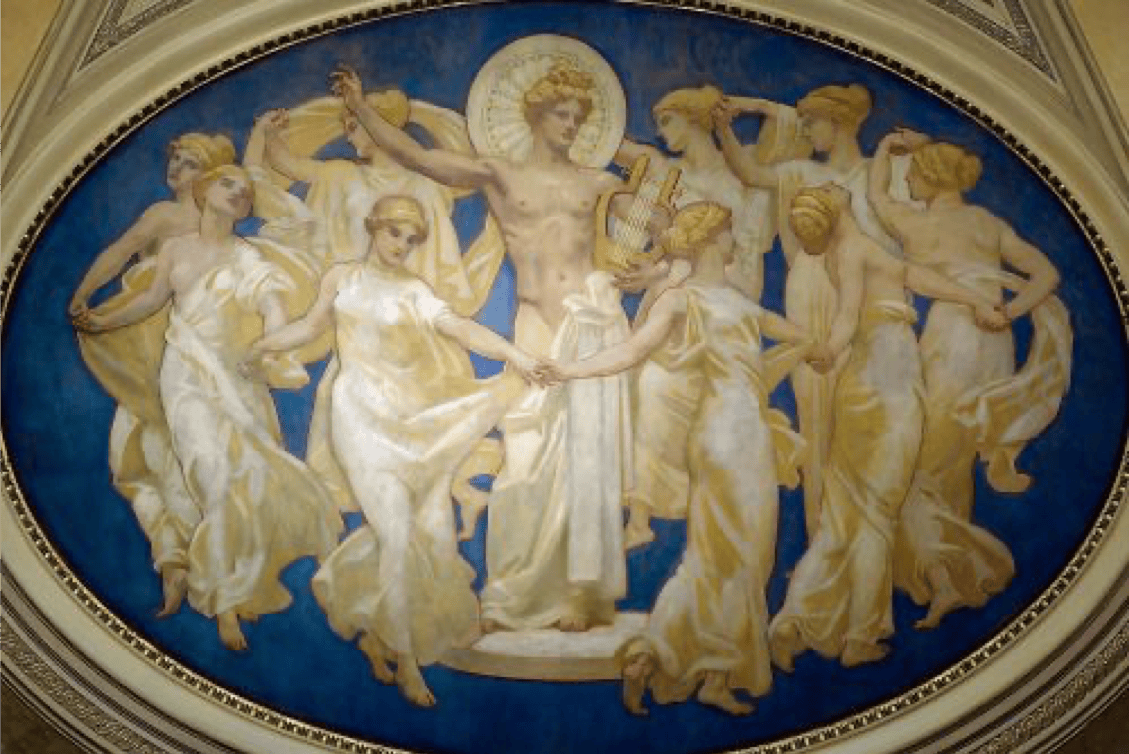
Apollo and the Muses – John Singer Sargent (1921) Museum of Fine Arts, Boston
… As soon as Zeus had ordered the cosmos, the gods gazed in mute amazement at the magnificence before their eyes; at last the father of the gods asked them if he had overlooked anything. Then these replied that only one thing could be missing: a voice capable of praising the great work and his entire creation in words and music.
But to do this required an entirely new divine entity: so the gods begged Zeus to beget the Muses.
This account says something totally different from what the psalmist declared, “The heavens tell of the glory of God, and fortitude proclaims the work of his hand.” It is not creation that needs to praise its creator, rather it still lacks something: the being of things is not yet accomplished until a voice is given to express it. Things and their glory must be uttered: this is the fulfillment of their essence. Therefore, none of the gods, among whom Zeus has apportioned the realm of being, is deputed to do this, since they themselves are an integral part of creation; they too are imprisoned in a silent, contemplating possession and can only pray to the Most High to awaken a voice that is capable of announcing and celebrating the wonder of the world.
For this purpose the Muses appeared, and this is the meaning of their divine being. They are goddesses in the full meaning of the word. The first phrase with which Greek literature speaks to us, namely the opening verse of the Iliad, is not by chance the invocation to the Muse, called only by the name “goddess.” Song and speech are consequently a divine office, originally brought to completion only through the work of a specific deity; they are therefore so inherent in the divine depth of things and their essence that in them, and only in them, is being revealed.
Consequently, this is the first task of the Muses in Olympus: to the delight of Zeus, to sing of the gods and their blissful life, their appearance in the world, the origin of all things and the mortal destiny of men.
… only from Mnemosyne, primordial goddess, will the chant of the Muse, the cosmic weaver,37 she who governs the world by singing it. For the Muse begins the chant not from the Foundation, but from Nothingness [non-being] – thus establishing a new, revocable order (táxis) of the cosmos.
For the Muse is not an impolitic celebrant, but tempers instruments and states: in the ideal pólis she would rule, where the political fabric had been well harmonized, generating an ordered cosmos. … the Muse, a cosmogonic deity, then holds all the planes of the universe in her hands: “for even the world [kósmon] can be called a myth [my´thon].”
… Hesiod boasts of their benefits: they accompany kings and dictate persuasive words to them, the words needed to appease disputes and restore peace among men. They confer on them the gift of gentleness, which makes them dear to their subjects. In the same way, says Hesiod, it is enough for a cantor, that is, a server of the Muses, to celebrate the deeds of men of the past, or the gods, so that those who have worries or sorrows forget them instantly.
… The cantor and the poet are completely dependent on the goddess Muse. “Descend to me, Muse, from your heavenly refuge!” Sappho invokes her (fr. 154). Without her presence, the poet can do nothing; only “by divine fate,” as Plato says (Ion 534 b), can he become a creator, bringing to light in the most appropriate manner that toward which the Muse impels him.38 That is why he is precisely called a poet and designates himself as server and follower of the Muses. … “Blind is the counsel of men, when anyone attempts the deepest path with intelligence alone and without the goddesses Heliconies,” it is said at Pindar (Paian 7 b).
… Their breath is what animates the poet; that is why he himself is called “divine,” and so is his chant.
[Hesiod in his Theogony:] … Thus spoke the daughters of the great Zeus, the truthful ones”; then happened the prodigy that made him a poet … Since they ‘know all things,’ not only the poet, but also the man of action must hearken to them and entrust his conduct to them. That is why Calliope, as Hesiod says, stands by even the most powerful rulers …
Calliope, of whom Hesiod says is the most eminent among the Muses and stands by the side of kings, is together with Urania, according to Platonic Socrates, the patroness of those who “live philosophically, giving honor to the ‘music’ (mousikø) of these deities.”
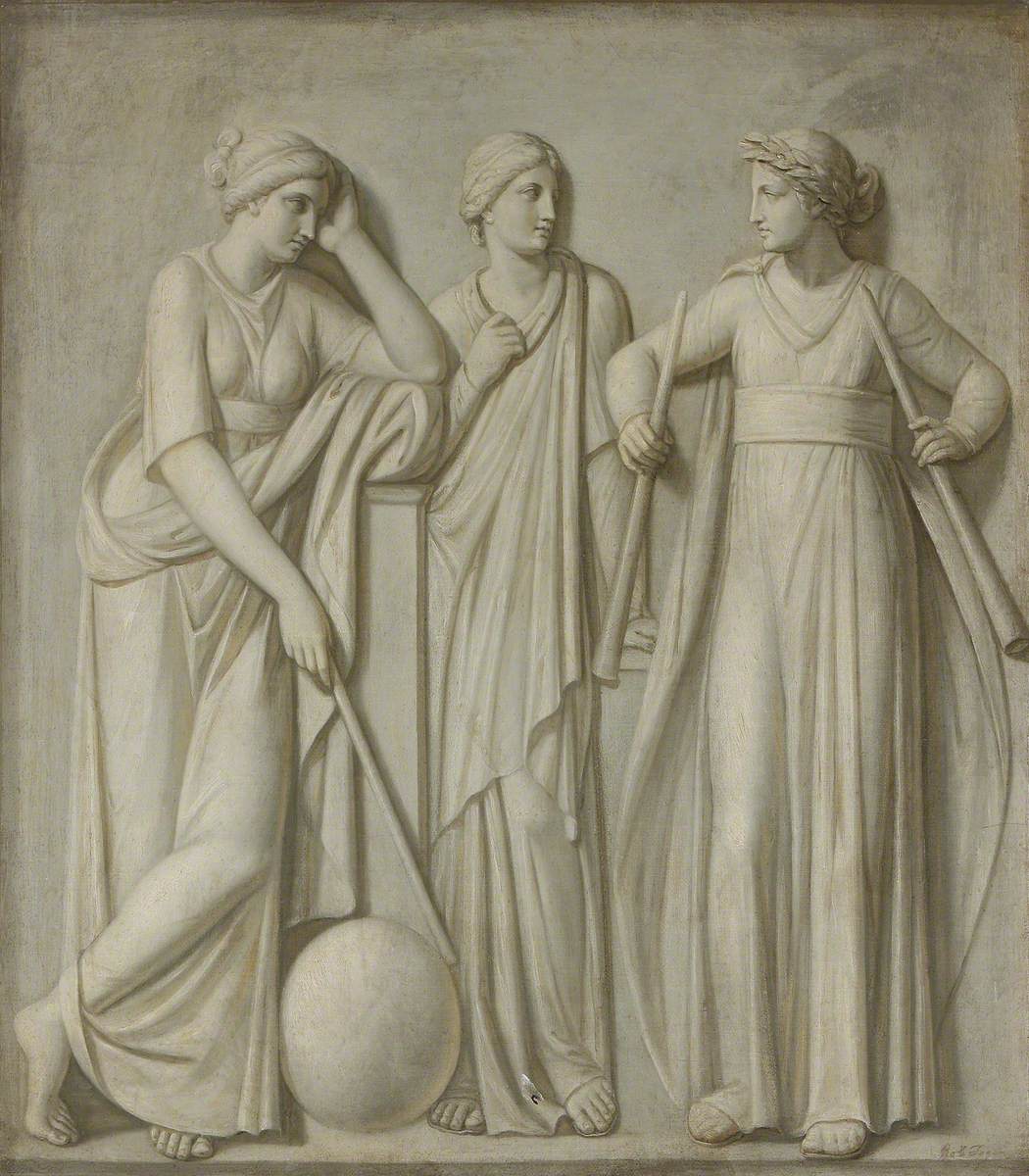
Fagan, Robert; The Muses: Urania, Erato and Calliope; National Trust, Attingham Park
… But not only philosophy was to enjoy the assistance of the Muses; all true knowledge and all sensible action found their divine origin in them. The warrior himself thanked them for clarity of spirit and sensibility; in fact, Plutarch reports that the Spartans sacrificed to the Muses before battle, in order not to be overwhelmed by the warlike impetus of the clash and so that their wisdom would remain transparent.” (WFO)

Illuminating, thank you.