


On the day of the heliocentric alignment between the Magister Musicae Mercury and the asteroid of the greatest of the Muses Calliope, Lady of the Art of the Word and the Power of Thought, of occult philosophy, we present the 6th chapter of the text The Academy of the Muses.
6. Musicality and the Art of Living
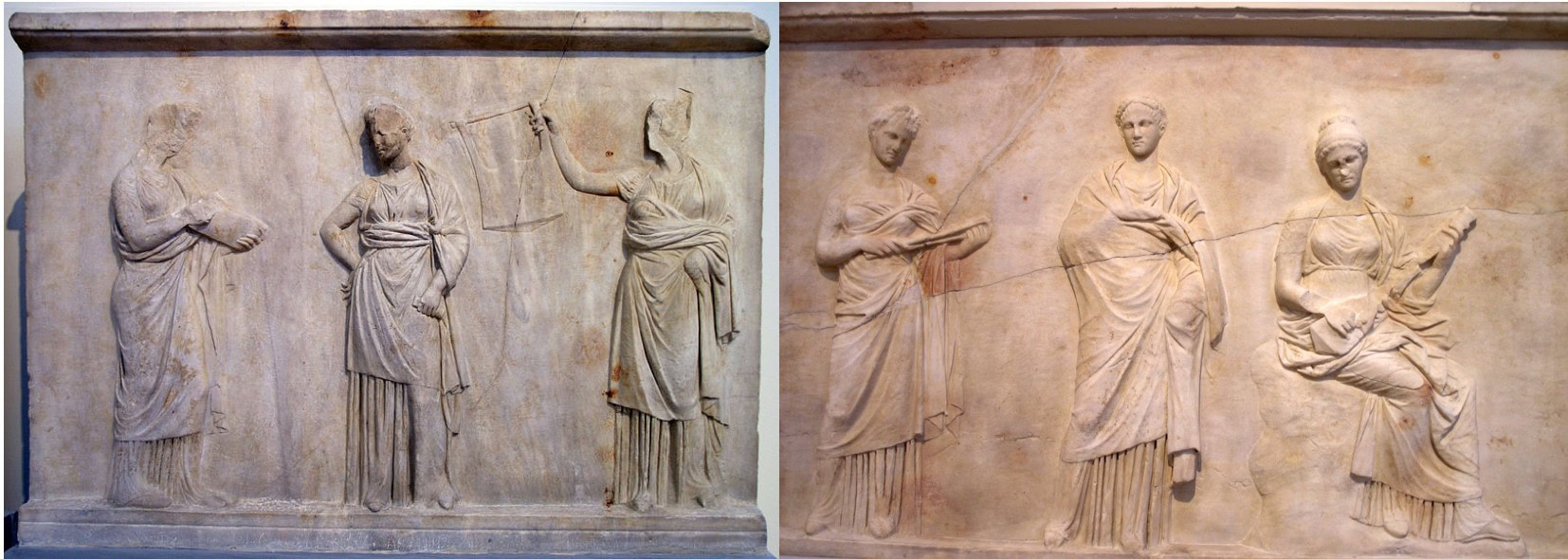
Clio, Calliope and Erato – Euterpe, Polymnia and Terpsichore, 4th century BC – National Archaeological Museum, Athens
“Silence has its own wonderful voice: music.
… the magic of sounds that goes under the name of “music” (mousikø) must be recognized as the gift of a divinity, indeed, as its own sacred voice … In chant a living knowledge resounds.
… the original Greek thought of the Muse reveals the being of things in music and accomplishes it, allowing the one called, who is a listener of the divine resonance and must reproduce it by means of his human voice, to express it again within his own experience.” (WFO)
“… According to the Teachings of Plato, music should not be understood in the narrow sense of music alone, but as participation in all the harmonious arts. In singing, in poetry, in painting, in sculpture, in architecture, in speech, and, finally, in all manifestations of sound, musicality is expressed. In Hellas a ceremony to all the Muses was performed. Tragedy, dance, and all rhythmic movement served the harmony of Cosmos. … Beauty is an uplifting concept, and each offering to beauty is an offering to the equilibrium of Cosmos. Everyone who expresses music in himself sacrifices, not for himself, but for others, for humanity, for Cosmos.
Perfection of thought is an expression of beautiful musicality. The highest rhythm is the best prophylaxis, a pure bridge to the highest worlds. Thus We affirm Beauty in Our Abode. …
You know about the special musical instruments that are in Our possession. … Often such singing has served to bring peace to the world, and even the servants of darkness have retreated before its harmonies. One should learn how to develop one’s own musicality by all possible means.
The heart’s feeling is sensed not in the words themselves but in their sound. There can be no irritation in harmony. Malice cannot exist where the spirit ascends. It is not by chance that in antiquity the epic scriptures were sung, not only to facilitate memorizing but also for inspiration. Likewise, it is rhythm and harmony that protect us against fatigue.
The quality of music and rhythm should be developed from infancy.” (SOV 1, 42)
“… We approve of everything that awakens a true sense of rhythm in people. The feeling of rhythm is inherent, but the disorder of chaos deadens it. People may act rhythmically, but still be far from an understanding of the great significance of rhythm. If someone wants to take a decisive action, his instinct can correctly prompt him to first establish the necessary rhythm, and in this cadence the required harmony is found. Even a limited effort will provide beneficent results.
We demonstrated the simplest rhythms of Mahavan and Chotavan,71 but one can learn far more complicated rhythms. Let us recall the most ancient meters of the Sanskrit language and of the worlds of ancient Greece and Rome. In them one can find highly-developed, well-considered patterns of rhythmic sound. The ancients knew the necessity for communion with Cosmos.
During certain periods of earthly tension, one should think very much about rhythm. The people’s cries of terror plunge them into the abyss of chaos. Do not think that We approve of feasting in a time of plague. But when a Hindu chants verses from the Bhagavad-Gita he acts wisely and the result is a healing harmony. Rhythm is both the cement and the wings of space.
People desire communion with Us; the first key for them will be the realization of their own inner rhythm. There can be the finest music and singing, yet nothing will resound in the heart that is deaf. In contrast, a refined heart will tremble in harmonious response to the rhythm. The seeker will then become better, more courageous and strong; he will be a worthy co-worker of the earthly and of the Supermundane, and will find joy.
Remember that Earth is suffering from an unusual state of tension. During the time of Armageddon how can one permit oneself to participate in this state of chaos? In all actions, great or small, think about this reminder. It is not well-being, but struggle, that teaches man to think. But what kind of warrior would he be if, in the first difficult hour he loses his guiding star, his thoughtfulness? How different would he then be from the unthinking ones, who cannot recognize a decisive hour, and for whom threatening events are only accidental. But he who thinks sensibly associates himself with cosmic rhythms, and in such an armor boldly accepts the battle. He is then with Us.
The Thinker said, “Muses, beautiful Muses! In your harmonious choir you give to humanity the salutary rhythm.” (SOV 3, 605)
Realizing the Rhythm of Harmony is the sacred Middle Way: the Fourth Principle is the evolutionary method(Harmony through conflict) of the human Soul to realize the Goal, Love-Wisdom, since “there is no love without harmony, nor harmony without love”. And to love Beauty is to remember our essential Unity and Harmony with the Cosmos and the Infinite:
“… continuous, concentrated thought about what one reveres most is the surest way to develop the memory. There is no need to burden the consciousness with petty details. One must first of all concentrate upon what has been chosen as the principal concept. … The Thinker constantly thought about His chosen Muse. He did not hide the fact that in days of turmoil He remained firm only because of Her; She was His source of strength and ultimately His salvation.” (SOV 3, 451)
“… if Cosmos is One, whatever one wants to introduce into its objectivity must respect its first law: Unity. What in it is asserted as disconnected from the One can only be transitory and condemned to disappear without leaving any memory; moreover, it exerts a harmful influence on the environment.
This is the real reason why modern art in general is disastrous, sinister and condemnable. Not so much for the errors of its theories (sometimes insane) but because it ignores or contests the unity of the Whole. … hearts are not yet educated to love the One. One tries, inevitably, to remedy these imbalances with decrees and prohibitions, with political acts, in short with external measures; in the meantime humanity, left without art, dies.
Recognizing Unity is urgent, if one wants salvation; and perhaps Art is nothing but the ability to lead oneself back to the One. The ways to obtain it are infinite, but the goal can only be one.”72
“… The pledge of happiness for humanity lies in beauty. Hence, We assert art to be the highest stimulus for the regeneration of the spirit. We consider art to be immortal and boundless. We make a demarcation between knowledge and science, because knowledge is art, science is method. Therefore, the element of Fire intensifies art and spirit-creativeness. Therefore, the wondrous pearls of art can actually uplift and transmute the spirit instantaneously. … Verily, the pearls of art bring exaltation to humanity, and the fires of spirit-creativeness can give a new understanding of beauty to humanity. Thus, We value integrity around the center and appreciate the Service to Hierarchy through the heart.”73
The Return to the One, to the Center, through the realization of one’s “own inner rhythm”, the conquest of musicality, of the art of living, is obtained through the overcoming and transmutation of conflicts in the Name of Harmony (4th Ray – 4th human Hierarchy):
“The capacity to suffer, which is distinctive of humanity, is the outstanding conscious reaction to environment of the fourth kingdom in nature, the human. It is related to the power to think and consciously to relate cause and effect. It is a process on the way to something undreamt of today. … It is related to an aspect of the creative intelligence, an aspect and characteristic peculiar to humanity.
… No other kingdom in nature creates forms, produces colour and sounds in harmonious relation, except the human; all of this type of creative art is the result of aeons of conflict, pain and suffering.
… [There will be] a close relation between this fourth purpose of Sanat Kumara [the Personality of our Planetary Logos], the fourth kingdom in nature, the human, and the fourth Ray of Harmony through Conflict. It is the balanced relation of these three, consummated at the fourth initiation, which produces the full beauty of the creative fixed design of the individual soul, or—on a different level of initiatory process—of the fixed design of the universal soul of the Lord of the World. The fourth ray being temporarily out of full incarnation at this time is the reason for the relative interlude in the production of human creative art of a very high order. The cycle of suffering is nearing its close, and we shall later see—when the fourth ray again swings into full objective activity [starting from 2025]—a recurrence of the arts on a turn of the spiral far more exalted than any lately seen.
… the ceremonial ritual of the daily life of Sanat Kumara, implemented by music and sound and carried on the waves of colour which break upon the shores of the three worlds of human evolution, reveal—in the clearest notes and tones and shades—the deepest secret behind His purpose … I am not here writing in symbols, but am making an exact statement of fact. As beauty in any of its greater forms breaks upon the human consciousness, a dim sense is thereby conveyed of the ritual of Sanat Kumara’s daily living.” (RI 243-4 e 246-7)
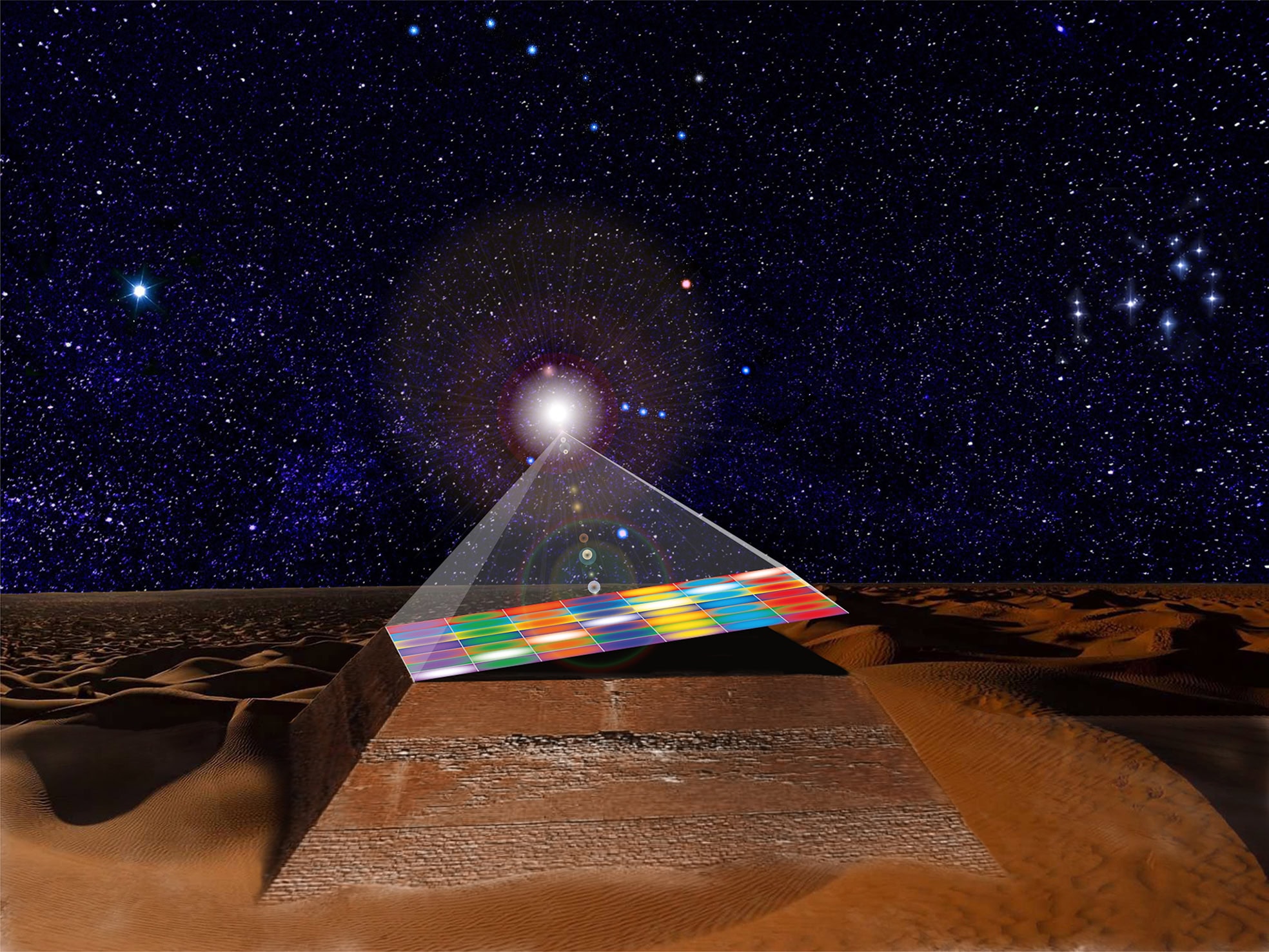
“The development of the new art. This will be expressive of a sensitive response to ideas. The art of the past expressed largely man’s understanding of the beauty of God’s created world, whether it was the phenomenal wonder of nature or the beauty of the human form. The art of today is as yet almost a childish attempt to express the world of feeling and of inner moods and those emotionally psychological reactions which govern the bulk of the race. They are, however, to the world of feeling- expression what the drawings of the cave man are to the art of Leonardo da Vinci. It is in the realm of words today that this new art is most adequately expressing itself. The art of music will be the next approach nearer to the truth, and to the revelation of the emerging beauty; the art of the painter and of the sculptor will follow later. [written in the 1940s – and what about the Seventh Art!]. None of this is the art of expressing ideas creatively, which will be the glory of the Aquarian Age.” 74
Here is the vision of the Academy of Muses!
Humanity expressing the creative art of the World of Ideas.
Mystical beauty and occult beauty. “There is a mystical beauty to be achieved, as we all know, through art. It conveys a general sense of beauty, colour and inspiration, and thus it clothes and veils ideas. There is an occult (hidden) beauty also to be achieved in the field of art. This conveys a different sense of beauty, colour and inspiration, clothed in those forms which reveal ideas. Mystical beauty veils, in beauty, the ideal. Occult beauty reveals, in beauty, the ideal. [… on these words and definitions] is to be found the secret of true creativeness. Meditate upon the distinctiveness of mystical inspiration and occult revelation and on their synthesis in all great achievement.”75
And so already Plato, the supreme Philosopher in love with infinite Wisdom:
“The intuitive flash of the transcendent idea is not only definitive grasping of the divine “truth,” but also transformation of the subject who arrives at such a result: “Do you not believe that then it will happen to him to give birth to true virtue and that in this way […] he will become dear to the gods and, if ever to another man this was granted, he will conquer immortality?” (212 a). This is the only “knowledge” worth conquering in the course of life. To nothing else should those who wish to call themselves true philósophos, “lovers of wisdom,” strive.
… Only he who is truly philósophos, only he who, with all of himself, is a “lover of wisdom,” is a true poet. And his work can be considered, for all intents and purposes, as the “most beautiful tragedy” because it is “a representation of the noblest and highest life” (Laws 817 b).
… As Plato has Socrates say elsewhere (Phaedo 61 d), the “love of wisdom” is megíste mousiké, “supreme music,” or, perhaps better, the highest form of knowledge and expression to which the inspiration of the Muses can guide men. It is a summit toward which every word and every song, every rhythm and every measure converge in symphonic accord with the harmony of the cosmos and the source of being.” (DSM)
… you were not made to live your lives as brutes,
but to be followers of worth and knowledge.’
(Inferno, Canto XXVI, v. 119)
For the love of wisdom and for the wisdom of Love, towards the Beauty of Being …
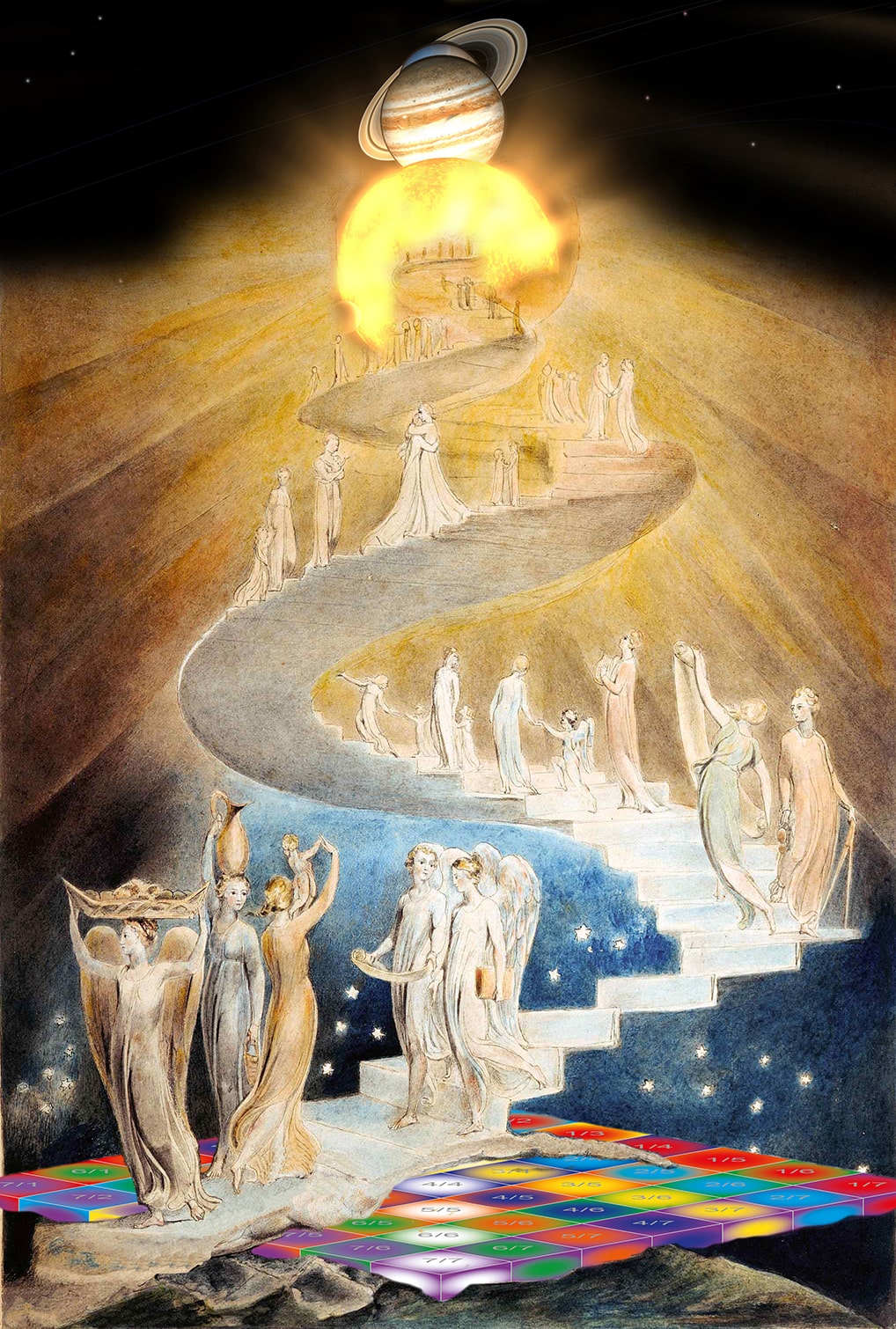

A lot of what is put before us as mainstream entertainment will hopefully become less salacious and/or violent. Whether it is intentional or not, there are children and others not sufficiently mature, exposed at present to unsuitable material.