“Carry to success the work that is pleasing to Me and useful to you, the friendly work that makes My House ready.
Gather images of love. Let love inspire you with an understanding of how to make My House more beautiful. Beseech goodness and inquire what contents would befit My House.
Let honor show you how the pure House is a manifestation of beauty. The manifestation of your work is like that of flowers.
I will not take a penny, but I will reward a hundredfold.” [1]
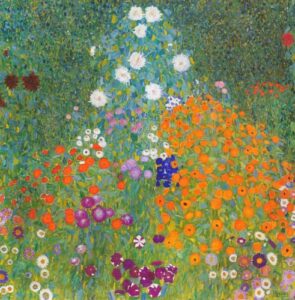
Gustav Klimt | Bauerngarten
.
This is how we began this etymosophical reflection [2] on inspiration, because the passage impels us into the heart of the subject.
Essentially, inspiration is the answer to a question we ask the spirit.
Inspiration is a delicate subject, because, in its usual sense, it has an evanescent halo that pervades various fields, from the impalpable personal presentiment to the sovereign influence in art, and it is also a very powerful concept, because its afflatus can rise to resonance with divine Reality.
In order to try to grasp its scent, let us start with the etymon.
The current form derives from the Latin inspiratio, breath, and, figuratively speaking, inspiration, originating from the verb inspirare, with both transitive and intransitive values: to inhale, to breathe deeply, to make a sound (of a wind instrument), to inspire, to infuse. This verb is composed of the preposition in, which indicates being in place, being “inside”, and the verb spiro, to blow, to breathe, to pulse (of the veins), to live, to aspire to something. Spiro derives from the Indo-European root *SPA-/*SPU-, which expresses precisely the idea of blowing strongly, with the change of U to I. From the same etymon comes the noun “spirit”, from the Latin spiritus, breath, air, breeze, breathing, life, vital principle, sound, voice, spirit as the “breath of God”, and, in a figurative sense, also inspiration.
The Latin spiritus, with its myriad of meanings of which only the most relevant have been quoted here, expresses the all-pervading power of this concept.
According to the etymon, therefore, inspiration means to be pervaded by the breath of the spirit: like the above-mentioned passage from Agni Yoga, the etymology restores and clarifies the powerful essence of the word.
The passage from the Gospel of John comes to mind, which in the Latin version also manifests in sound the identification between the breath of the wind and the breath of the spirit:
“The wind (spiritus) blows (spirat) where it wills, and you can hear the sound it makes, but you do not know where it comes from or where it goes; so it is with everyone who is born of the Spirit (ex Spiritu).” [3]
These are the words that Christ addresses to Nicodemus, a leader of the Jews who comes to him at night, fascinated and at the same time doubtful, to ask him questions: Christ speaks to him of the need for a rebirth of the spirit by associating it with the voice, the imponderability, the power and freedom of a breath of wind.
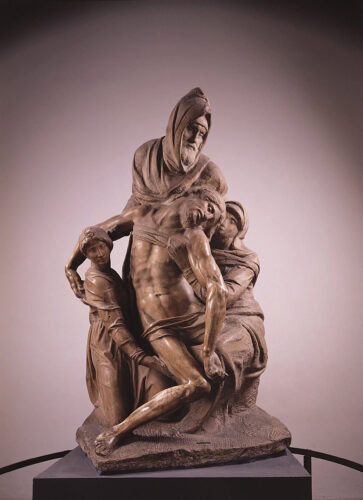
Michelangelo Buonarroti | Pietà Bandini (The Deposition)
Museo dell’Opera del Duomo – Florence
.
The sculpture by Michelangelo depicted here shows us Nicodemus as he lays, with Mary and Magdalene, the body of Christ from the cross: the sculptor identifies with him, giving him his own features.
[…] A laborious work, rare in a stone and truly divine […], as Giorgio Vasari described it in his Life of Michelangelo, in 1550, an appreciation still shared today by Timothy Verdon, director of the Museo dell’Opera del Duomo in Florence, who recently said: while today it is spoken of, like other sculptures by Buonarroti, as an “unfinished work”, the term that best applies to it is perhaps that of the 16th century, when it was still called “infinite work”.
This sculpture, the so-called “Pietà Bandini”, projects us into the world of art: of this world we shall speak here in passing, since it is known to be the acknowledged home of inspiration.
Moreover, in these pages in the current year we are precisely celebrating, in resonance with Goal 6.4 of the Table of the Plan, ‘Religiosity and intelligent communion of Art’, the Muses, the living Substance of the spiritual Triad, recognised by the Greeks who acknowledged and named them, and in any case honoured by all peoples.
In this context, it seems noteworthy to elaborate on an observation that associates the etymon of ‘Mnemosyne’, mother of the Muses, once again with a breath, in this case with the ‘vital Breath of the Waters’, as the linguist Rendich writes: “In the first Indo-European language, the consonant n was the symbol of water. With it was constructed the verbal root an ‘which initiates [a] the vital breath of the Waters [n], that is ‘to breathe’. According to the Indo-Europeans, man, in breathing [an], exhaled the vital energy brought to earth by the cosmic Waters, considered ‘mothers’ … and generators of all the mobile and immobile things of creation. Suffice it to say, in this regard, that the Sanskrit verb jan [j (energy that comes) + an], “to generate” is compounded with the root an, as are the Greek word genos and the Latin genus, meaning ‘birth’. [4]
From the Indo-European root *MAN-, in which the initial sound m, prefixed to an, expresses the idea of relationship, there arose in Sanskrit the verb man, ‘to think’, the noun muni, ‘inspired’, ‘seer’, and the Greek terms Mnemosyne, ‘mother of the Muses’, ‘memory’, manía, ‘the thought expressed by the divinity’, manteia, ‘the art of divination’.
The etymon of Mother of the Muses thus leads us back to a thought inspired by the breath of higher, life-giving Spheres.
We can still note that the SP sound of spirit takes us back to a masculine, active Origin, in which the p (remember the Greek word pyr, “fire”) symbolically represents the fire of the Father, while the MAN sound of Mnemosyne leads us back to a feminine Origin, to the waters of the Mother: the two sounds are unified by the idea of a generating vital breath, an impulse to creativity, a powerful current that puts us in contact with the higher Principles that balance the cosmos.
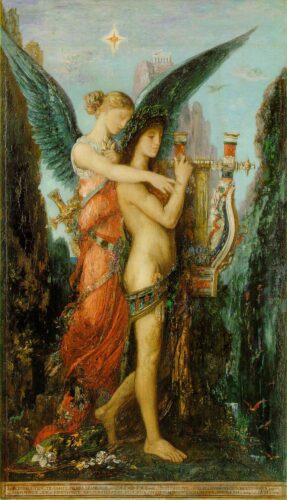
Gustave Moreau – Hesiod and the Muse | Musée d’Orsay – Paris
.
As it has already been reported in these pages (in the Introduction to the text The Academy of the Muses), it is with an invocation to them, Olympian deities, daughters of Zeus and Mnemosyne, that Homer sought inspiration for the primordial poetic song of our culture.
It is of primary importance to point out that in the ancient Tradition the Muses presided over every sphere of thought: not only over the many expressions that we today call artistic, but also over historical, mathematical, astronomical research, the entire world of Thought and its manifestation. Their powerful characteristic was to be a chorus, in which each one, depending on the need for specific intervention, took in turn the most relevant role. Thus, e.g., the philosopher Heraclitus, in the 6th century BC, also felt inspired by them. Diogenes Laërtius, in his collection of Lives of the Philosophers, reports the thinker’s fierce indignation at the incomprehension of his contemporaries: Heraclitus I am. Why do you draw me up and down, you untouched by the grace of the Muses? My work is not for you, but for those who understand me.
Art and science, originally united, have over time separated, pursued each other, intertwined, through magnificent exponents and humble seekers, together on the threshold of mystery, and today they feel, at least in some, that their common inspirational current, transcending the rational terrain, rises in the tension of research, in creative imagination, in openness to the infinite, in intuition, which is the direct knowledge of ideas inspired from on High and understood by the enlightened mind.
Turning now to ‘inspiration’ in a more methodical way, in the process of the evolution of consciousness, we see that it is a keyword used by the esoteric Teachings to indicate the connection with the Hierarchy‘s work of stimulation and, in particular, the final path of discipleship. In Esoteric Astrology we read [5]:
“[…] We might consequently state that the forces of:
- Cancer—Capricorn—Saturn (which are an expression of Sirian energy) enable the aspirant to tread the Path of Purification, of Probation. […] They pour through the Hierarchy upon the mass of men and enable the unit in that mass to “isolate himself and turn his back upon the past and find his way on to that section of the Path wherein he learns to feel”.
- Gemini—Sagittarius—Mercury (which are an expression of the Pleiades) enable the Probationary Disciple to pass on to the Path of Accepted Discipleship. He is then becoming increasingly intuitive and entirely one-pointed whilst the nature of the pairs of opposites is clearer to him. […] The man “presses forward on that Path wherein he learns to see”.
- Aries—Libra—The Sun (which are an expression of the Great Bear) bring about that focussing of energy in the life of the disciple which makes it possible for him to function consciously and with intention upon the Path of Initiation. […] He now knows, through transcended feeling and from identification with the seen Vision, the true meaning of being.
This threefold process can also be covered by the three words: Sensitivity, Illumination and Inspiration.”

It is with this significance that the idea of inspiration shines through in Vortex 3.6 of the Lambdoma Synthesis, with the following definition:
Inspiration is resonating to the divine Reality
This thought echoes such a definition:
“Be silent, O strings, that a new melody may come to me,” says a hymn of the Greek Mysteries. Such rebirth of spiritual harmony is not a “void”, as it is sometimes called. To open the heart does not mean to devastate it; on the contrary, when the last reverberation of the chord dies out, let the striving of the spirit immediately become more acute, in order to reach a more exalted harmony.” [6]
In summary and in simplicity, the idea of inspiration speaks to us of spiritual essence, of rebirth, of creativity, in all spheres of life and “in chorus”, that is, together in ordered groups, in the beauty of the common endeavour.
We conclude these notes as we began them, with thoughts from Agni Yoga:
“[…] How does the Brotherhood live? How does the Brotherhood act? From Our Abode the threads of Our creativeness are stretched to the hearts, as inspirations to humanity.” [7]
“Urusvati is deeply aware of the significance of the creativity in people. We direct Our thought along the lines of cooperation and nationwide creativeness. It is time to realize that people’s creativity is an inspired affirmation of their value. In all Our labor We allow time to inspire multiform creativity. Not only those who have dedicated themselves to art, but the entire nation should direct its thoughts to creativeness. […] It is almost impossible to tell people how to create by thought. They do not believe that strings can resound in response to the currents of thought. They do not believe that dry pigment can be gathered into harmonious images under the pressure of thought. And yet, people do know about the designs created in sand by rhythm. They admire the designs made by frost, and are not surprised when strings resound to distant rhythms. But thought produces the most powerful rhythms, and with such vibrations one can create.” [8]
____________________________________________________________________-
[1] Agni Yoga Series, Leaves of Morya’s Garden II § 24
[2] Today the heliocentric conjunction between Saturn, Mercury and Neptune occurs: the conjunction of the latter two Luminaries is associated with the harmony of language. There is also a conjunction between the Earth and the asteroid/Muse Euterpe
[3] Gospel of John, 3;8
[4] F. Rendich, Comparative etymological dictionary of classical Indo-European languages, 2010
[5] Alice A. Bailey, Esoteric Astrology, pp. 466-7
[6] Agni Yoga Series, Fiery World I § 416
[7] Agni Yoga Series, Hierarchy § 29
[8] Agni Yoga Series, Supermundane § 53