On this day rich in the Music of the Spheres (Mercury conjunct Earth; the Muses/asteroids Erato and Urania heliocentrically conjunct in Aquarius; Saturn conjunct the Muse Clio in Pisces) we publish the 5th chapter of our research on the Nine Muses, the Divine Singers of Beauty, Goodness and Truth.
In the figure’s monument, carved for an unknown poet in a shrine dedicated to Apollo and the Muses, the full nine Muses together with Apollo are reproduced in the two middle bands of the relief, below Zeus and Mnemosyne.
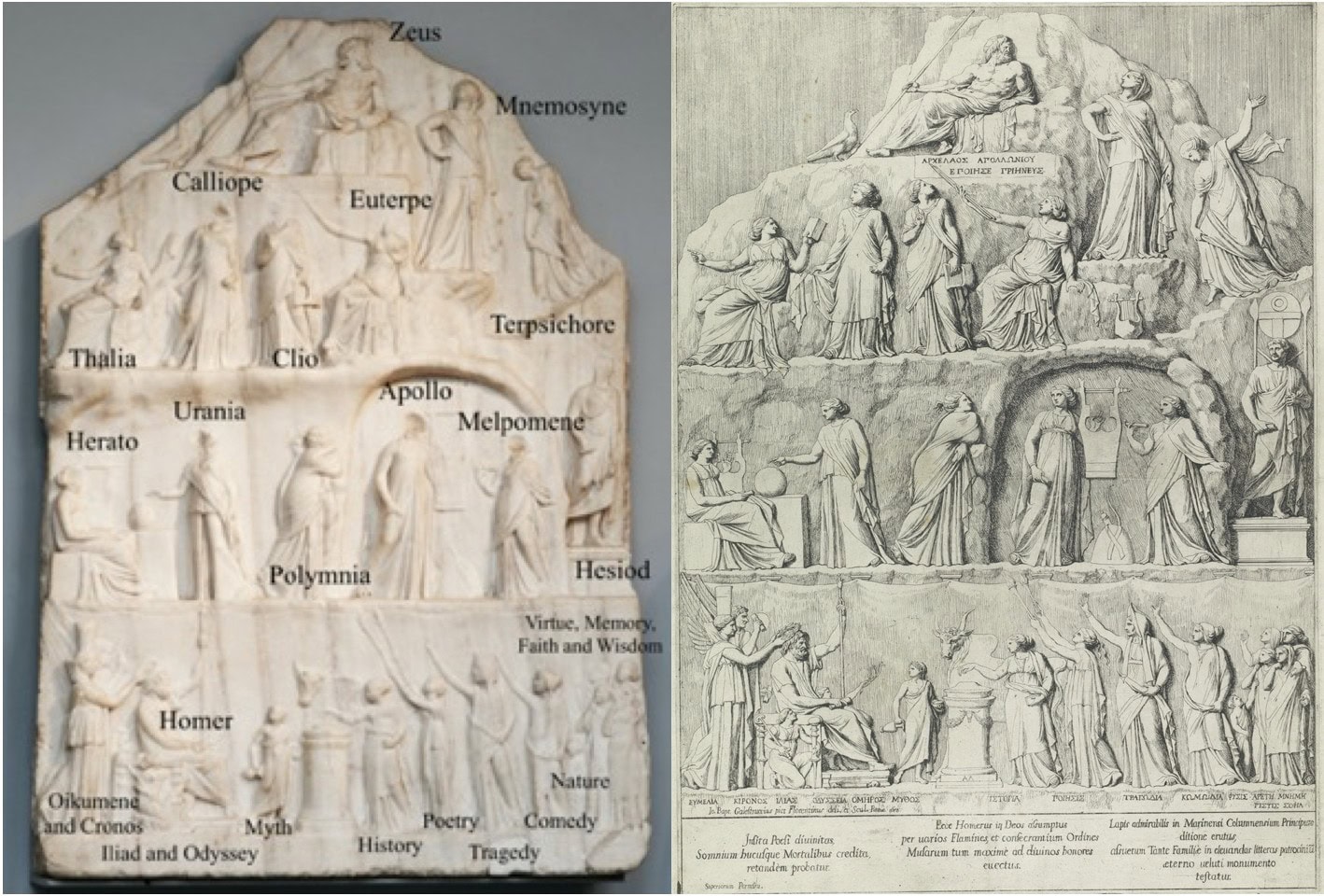
Votive relief of Archelaus of Priene with the Apotheosis of Homer (mid 2nd cent. BCE). – British Museum
“The bas-relief is divided into three or four bands. In the lowest towers Homer, resembling Zeus; behind him stand the god of infinite time and the goddess of ecumene, crowning him; in front of him Mythos and Historia sacrifice on a round altar, and the protective genii of the various species of poetry approach with blessing gestures. Above, on the other hand, in the second and third bands, stands the mountain of the Muses, with at its foot the sacred cave in which Apollo stands holding the lyre; a Muse brings him the papyrus of the poet Hesiod, whose statue can be seen near the cave, along with the tripod he obtained as a prize for victory. The other Muses spread out in a variety of attitudes and occupations on the slopes of the mountain. But a change is introduced as the gaze ascends the mountain: the Muses on the slopes of the mountain still wait in perfect stillness, while moving slowly toward the summit the goddesses become more and more excited, until the last one, just below the summit, bursts into the movement of dance. Higher still is placed the father of the gods, with his majestic head turned toward the mother of the Muses, Mnemosyne, who stands a little below, conversing with him in a regal attitude.
The sculptural work shows in the most expressive way how it is the spirit of Zeus that moves the Muses, who in fact call themselves his daughters. The Nymphs, too, are called daughters of Zeus; for the Muses, however, this connection with the highest god takes on a special significance: they not only have a common father, like the Nymphs, but also the same mother, Mnemosyne, who celebrated the wedding with Zeus … Therefore, the Muses constitute, unlike the Nymphs, a concluded unity; for in spite of their recognizable multiplicity, one always remains aware that they are in the end one Muse. The Homeric poems begin with the invocation of the (one only) Muse, and even later the Muse will be invoked together as both a multiple and a single deity, a circumstance unthinkable for the Nymphs, since the latter can only be called “ladies,” while “Muse” is an authentic proper name. Whether the Muses, like the Nymphs, also bear personal names in addition to their common name does not alter this difference at all: through multiplicity their unity is only reaffirmed, since they are not indistinctly many Muses, but constitute in the first instance, like the Charites, a group of three, which by multiplication has expanded to the figure of nine. (…) The figure of nine, which we first encounter in one of the verses of the Odyssey (24, 60), updated by the ancient grammarians and then in Hesiod (Theog. 77), where we find the nine proper names that became famous, has notably prevailed. Thus a Platonic epigram (16) that purports to honor Sappho may celebrate her as the tenth Muse.” (WFO)
One, Three, Nine Muses who over time acquired diverse attributions in the various authors, including, in addition to poetry, music and dance, the fields of prose and of sciences: Clio from epic poetry became the protector of History; Urania from astronomical epic (i.e., related to the description of the origins of the constellations) became sacred to Astronomy, and Thalia in addition to comedy was also associated with agriculture. The Muses thus set out to protect every field of human wisdom and, in later times, watched over the physical and spiritual education of human beings together with certain gods, notably Hermes, Heracles and Athena.
Now, to trace back to the Ennead or primary Triad of Principles that the Muses ‘entify’ beyond their ‘worldly’ attributions, let us go on to meet such Deva Olympian Deities one by one, and we shall do 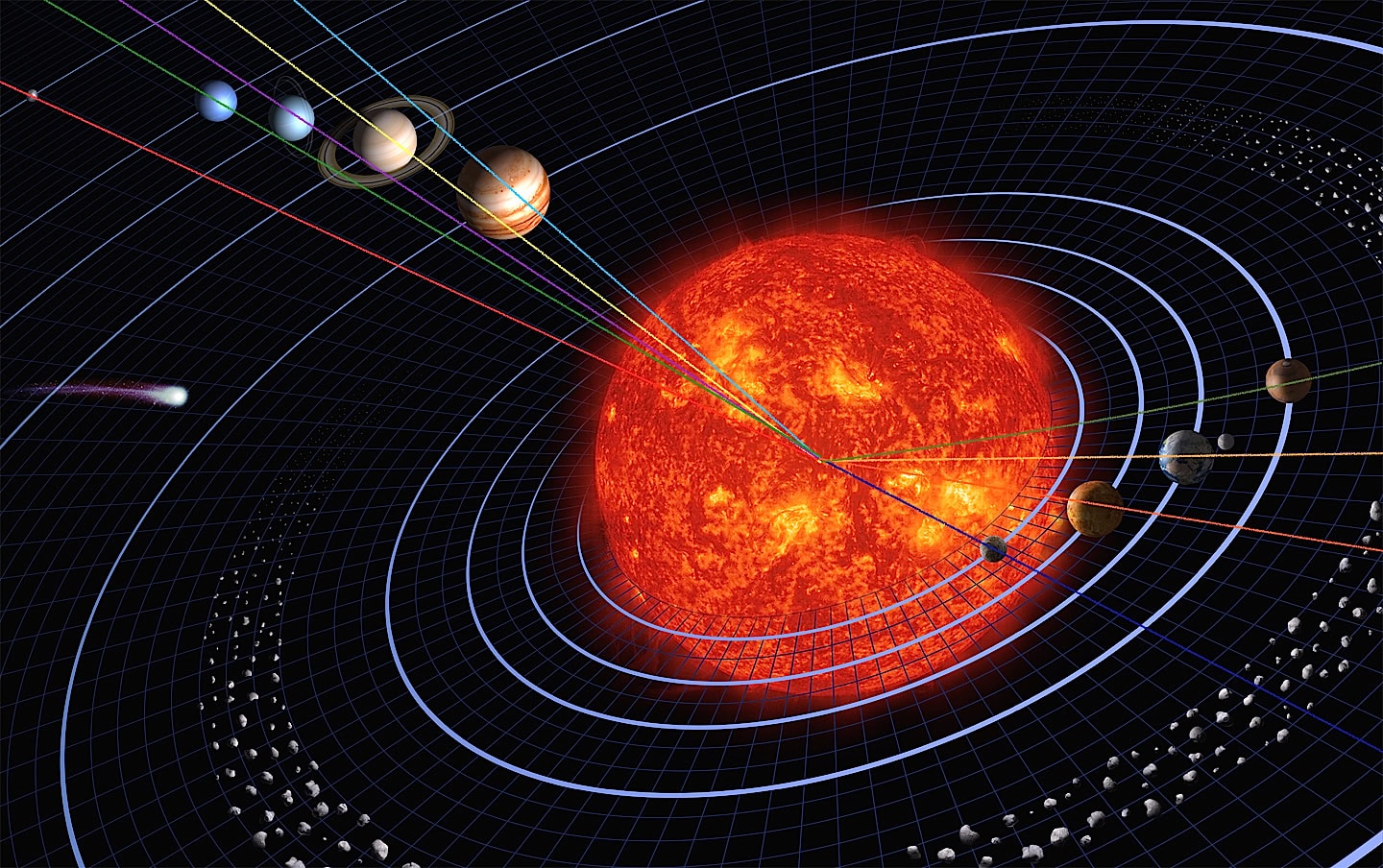 so trusting again in the astrological/astronomical key to the Mysteries, considering their reflections in the Firmament, i.e., Their solar bodies of expression, the nine planetoids/asteroids (=“star-like”) that bear Their Names: according to the assumption of Esoteric Astrology, the Science of Spatial Relations, the Names of the celestial Entities are precisely not given at random, but with wisdom of the cause by the inspired collective intelligence, capable of responding to the Sound within the ‘astronomical vehicles’ of manifestation of such Logoi and Great Devas.
The progressive motion and influence of the nine asteroids/Muses, in relation to that of the Planets and Zodiacal Signs, can then be computed and interpreted according to the practice of Astrosophic Wisdom: thanks also to this key, the listening to the Music of the Spheres, to the World of solar Ideas, will be able to substantiate itself more and more widely and precisely to our consciousness.
“The circle of the planetoids. Students of the Ageless Wisdom are apt to forget that the Life of the Logos manifests itself through those circling spheres which (though not large enough to be regarded as planets) pursue their orbital paths around the solar centre and have their own evolutionary problems and are functioning as part of the solar Body. They are informed—as are the planets—by a cosmic Entity and are under the influence of the Life impulses of the solar Logos as are the greater bodies. The evolutions upon them are analogous to, though not identical with, those of our planet, and they swing through their cycles in the Heavens under the same laws as do the greater planets. …
[The] Ray is dependent upon the quality of the hierarchy of Beings who use it as a means of expression. These seven hierarchies are veiled by the Rays, but each is found behind the veil of every ray, for in their totality they are the informing lives of every planetary scheme within the system; they are the life of all interplanetary space, and the existences who are expressing themselves through the planetoids, and all forms of lesser independent life than a planet.”39
As for the Muses, Their asteroids are all in the main belt between the orbits of Mars and Jupiter, understood as the effect of an ancient Battle of the Heavens; for the evolution of consciousness, this circle is the ‘place’ of communication between the spheres of ‘personal’ and ‘transpersonal’ planets, thus bridge to reunite desire (Mars, solar plexus) with love (Jupiter, heart center), the desire-mind (kama-manas) of Personality to the love-wisdom (Buddhi-Manas) of Soul, through the musagetes of the higher Mind (the Divine Hermaphrodite Mercury-Venus, Hermes-Aphrodite, but also Apollo-Athena), that Intellect of Love that ‘breathes out’ the Music that leads back to Oneness.
Here are the Nine Muses:
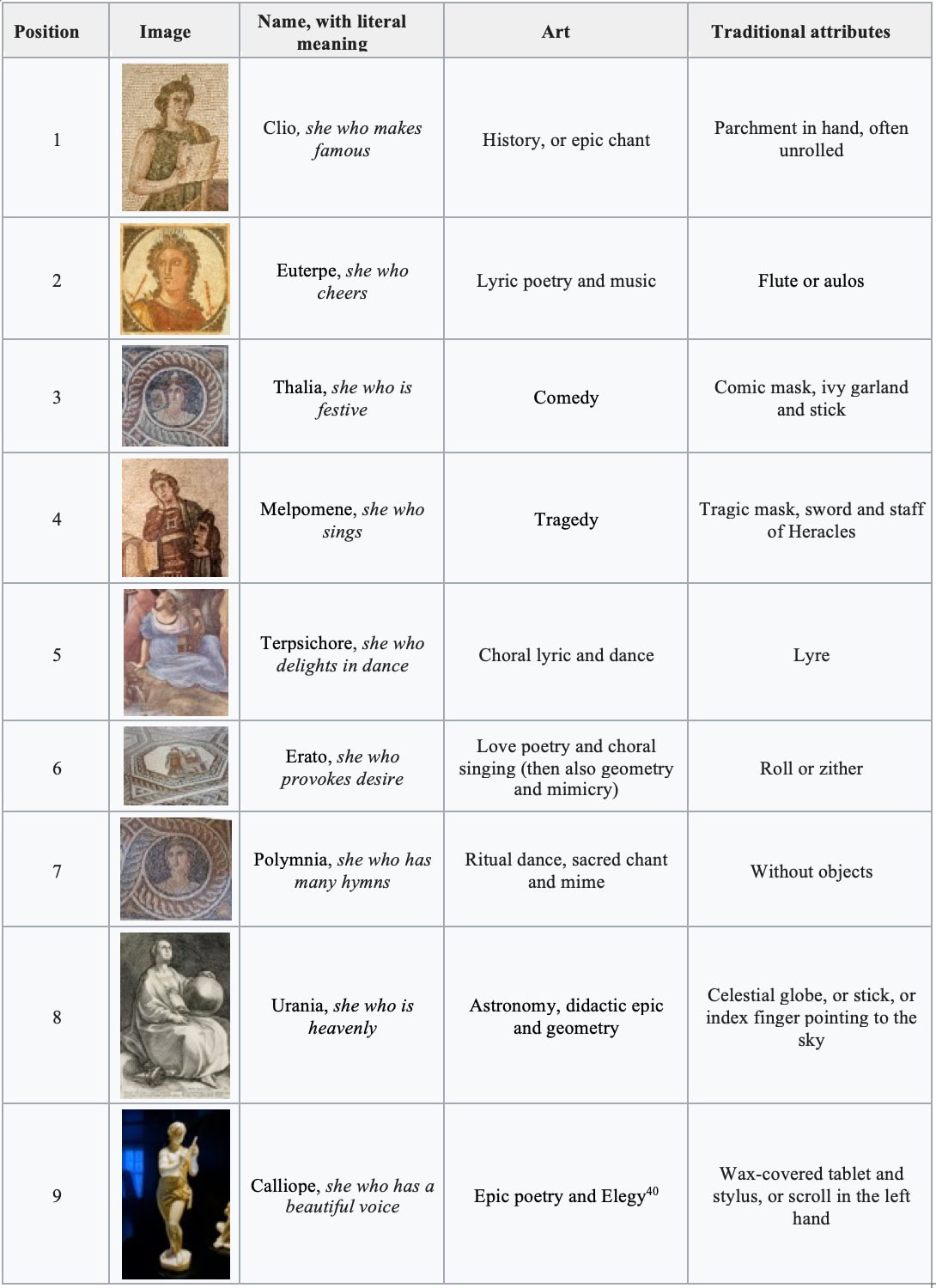
(Translated from Wikipedia: Muse)
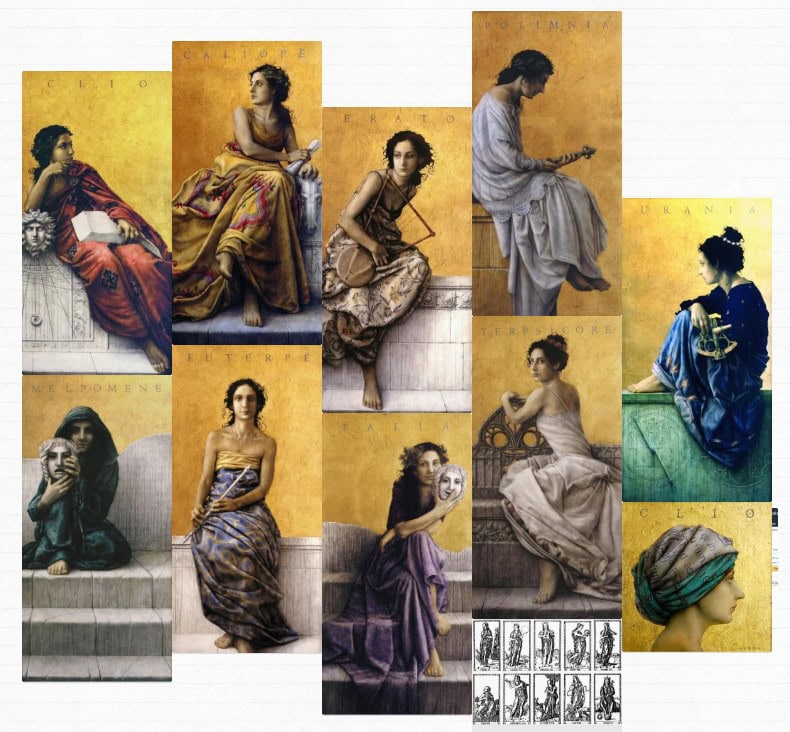
And here, summarizing the arts and qualities held by the Nine Muses, is a hypothesis for their esoteric values, the heart of this study:
Clio (she who makes famous): history and epic, for to proceed wisely one must value the Good and know the lessons of the past. Valuing and appreciating heroism.
Euterpe (she who cheers): music and poetry, which harmonize and sublimate emotions, bringing balance. Musicality-harmonization.
Thalia (she who is festive): comedy, celebration. Art of divergence/amusement – Joy, irony.
Melpomene (she who sings): tragedy. Depth, gravity, integrity.
Terpsichore (she who delights in dance): dance and choral lyric, movement that prepares for the sacred, dance to access sacredness by the soul. Art of sacred movement – adaptability.
Erato (she who provokes desire): love poetry, that which awakens eros, the beauty and strength of feeling, desire; also Muse of choral singing and then geometry and mimicry. Ardor/eros.
Polymnia (she who has many hymns): Sacred and ritual dance and choral singing, mime as rhythm. Rhythmic sacredness and solemn intimacy.
Urania (she who is heavenly): astronomy and astrology, she who rules the heavens with her myths (didactic epics), the motions and geometries of the heavenly bodies. Wisdom of Heaven (outer and inner).
Calliope (she who has a beautiful voice): Eloquence, epic poetry, elegy, the grand narrative, initiatory texts. Art of speech and thought-form construction – occult philosophy.
[For details on the Nine Asteroids-Muses see the full text, which will be published on September 14]
*
39 TCF, 1176 e 1196.
Asteroids, compared to sacred and non-sacred planets (bodies of expression of planetary Logoi capable of functioning according to Their animic or personal Ray), are minor Agents:
“… there are centres of energy in man which are not purely etheric centres but are the product of the interaction of the etheric centres and certain forms of negative energy of the lowest kind. Such, for instance, is the heart. There is the heart centre, one of the major centers on the etheric planes, but there is also the physical heart which is an energy generator also; there are the lower organs of generation which are equally a reflex product with an energy which is the resultant of the higher vibrations yet which has a quality all its own. This has its correspondence in the solar system. Many are the lesser planets and numerous are the planetoids which have an energy or attractive quality all their own and which, from the systemic standpoint, must be allowed for in the measuring of the attraction producing the forms of or upon any particular planet.
As we know from a study of the Secret Doctrine, certain of the planetary Logoi are pure and passionless whilst others are still under the domination of desire and of passion. (S. D., I, 214, 449; II, 223.) This quality of Theirs necessarily attracts to Them that which They need for the due expression of Their life in any scheme, and controls the nature of those egoic groups who are (for Them) generating force centres.
… there are three planetary schemes which hold a place analogous to that held by the pineal gland, the pituitary body, and the alta major centre, but they are not the schemes referred to as centres, or known to us as informed by planetary Logoi. Certain of the planetoids have their place here …
… the planetary schemes (the seven sacred planets) will eventually synthesise, or absorb the life of the planets which are not termed sacred and the numerous planetoids, as far as the four kingdoms of nature are concerned.
… Some are purely mahatic or of the third Aspect, dominated by the devas. Others (of which the sacred planets are examples) are controlled by the second Aspect, and that second aspect will work through unconquerably into manifestation. A few, like our Earth planet, are battlegrounds, and the two Aspects are in collision, with the indication of the eventual triumph of the “white” magic.” (Ibidem, p. 1189-90, 1164, 1172, 1127)