


[Article by Andrea F. and Roberta C.]
The Beauty of Death
Accompanying the dying on the Path of Beauty
“Birth and death appear as discontinuous phenomena
to those who regard only the visible world as real.
But if the spirit recognises the infinity of the invisible,
birth and death disappear altogether
and what remains is the perfect continuity of life.
No one dies because no one is born.”
(Commentary on Infinity I § 70)
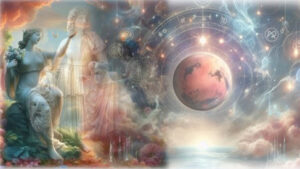
Today, on the day of the heliocentric conjunction between Mars, Solar Warrior, guardian of all battles, and Melpomene (Asteroid 18), the divine Muse of tragedy, in the sign of Scorpio:
Let us contemplate the Beauty of Death!
“Urusvati knows the true meaning of continuity. Most people fear this natural phenomenon, and invent many explanations to support their desire to believe in interrupted existence.
Some of them even believe that sleep is an interruption, forgetting that sleep brings the renewal of rhythm and contact with Higher Forces. Others go still further; they do not want to understand that departure from the earthly state is simply a change in a person’s state of being, and hope that so-called death ends life.
The phenomenon of continuity is an aspect
of the beauty of World Creation.
It can be understood as a form of tension.
One may garb oneself in a new garment, but the seed of the spirit lives in continuity. It not only lives, it also responds to the Cosmic Magnet.
Is humanity in such a low state that it does not realize the beautiful law of ascent?
If we cannot dare to hope that man will fully accept the law of World Creation, let him at least harken to the harmonious voice of nature, and admit the existence of the supermundane life.
Thus We shall find a point of contact and can restore mankind’s consciousness to health.
The Thinker used to say, “Accept continuity, it will lead you to the Gates of Eternity”. (Supermundane § 871)
Mars, the Templar of Love-Desire who translates the will of Vulcan (1st Ray of Will and Power) into action, the unstoppable force that manifests victory and triumph, is in conjunction with Melpomene, She who sings of Love and Sacrifice: their relationship expands the attainment of Harmony and Art through the transformation of deep conflicts and ‘pains’, leading to the death – by transformation – of that which is crystallised and therefore no longer necessary.
On this day, sacred to death, where Scorpio introduces death by suffocation that liberates man in the planetary Centre we call Hierarchy (Esoteric Astrology, p. 98), as Disciples we unite our perception and consciousness to the Hierarchy and see, through the eyes of the Heart, the most sublime aspect of this divine entity, Death, in the light of its beauty.
How do we explain to the materialist culture that death itself is Beauty, Harmony and Transformation?
Through the application of observation, loving understanding and intuition, we will see death as the divine essence of beauty, the agent of transformation and unconditional love.
Since ancient times, death was experienced as a natural, cyclical event, and reincarnation was a natural consequence of the laws of nature. This process of continual birth, death and rebirth is present in everything around us, all it takes is to see it with the eyes of the consciousness of the Heart, allowing all the mists of illusion that our personality has created over the course of our existences to clear away.
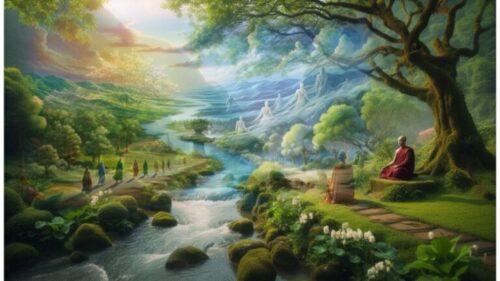
To be born here and to die here,
To die here and be born somewhere else,
to be born there and to die there,
to die there and be born somewhere else:
this is the wheel of existence.
(Words from the Buddhist text: Milinda’s Questions)
Due to the personalistic and power-driven drifts of Western man, when it comes to mass culture the ancient mysterial knowledge has fallen into oblivion, since masses tend to cling to dogmatic and separative versions. This has generated doubt and altered the image of death, qualifying this great adventure as terrible, disturbing, destructive and establishing in men’s emotional consciousness uncertainty about what exists beyond its veil.
The leitmotif of the materialistic perspective is that we must extend physical life as much as possible, only in this way can we defeat death.
“In the consumer society, the dying person does not know how to die and the doctor is incapable of explaining to him the meaning of death. The process of dying ceases to be an adventure consciously undertaken to become an absurd event.” (Jean Ziegler)
This view has fuelled the fear of dying, feeding this lunar energy to excess, and separating man more and more from the knowledge and art of living and dying.
“Like every living being, man undergoes death, but unlike all others he denies it with his beliefs in the afterlife. Death is indeed the most naturally biological event but also the most cultural, the one from which most myths, rites and religions are born.” (Edgar Morin)
We have forgotten that the process of dying is a true Art, and as such expresses true beauty, in the eyes of those who know how to see.
“We have made thee a creature neither of Heaven nor of Earth, neither mortal nor immortal, that thou mayst, free and proud master of thy being, mould thyself in the form which thou wilt prefer. It will be in your power to descend into the most brutish and lowest forms of life; you will be able, through your decision, to rise again to the higher orders whose life is divine.” (Pico della Mirandola – De hominis dignitate)
“As a heavy fate the thought of death hangs over the human consciousness. The specter of death is present as an inevitable cup, and having traversed the entire path of life, the spirit concludes that here one must terminate one’s existence. Such is the plodding of the spirit dissociated from Cosmos.
Ignorant of the beginning and seeing only the end, the dissociated spirit aimlessly passes through life. But everyone may earn immortality by admitting Infinity into his consciousness. Fearlessness toward death and striving toward the Infinite will provide the spirit with the direction to the spheres of cosmic endlessness.
Affirm yourselves in the acceptance of immortality, and infuse into each of your actions a spark of the creativeness of the Cosmic Fire, and that inexorable fate will be transformed into the one call of cosmic life. Our great, just law has chosen you as participants in the universal manifestations! Cognize immortality and cosmic justice! A beautiful step is prepared for everyone. Find the path of thinking about immortality!” (Agni Yoga – Infinity I § 70)
Now we want to recount what it means for the esoteric vision to accompany the dying on the path of death, how this process can be experienced in beauty and in harmony with life, momentarily leaving aside the esoteric aspects of the art of dying, but observing and understanding what it means to “be there”, in that moment of great transformation, hoping that this small seed of beauty can grow where fear rules.
How to accompany the dying
The first thing to know is that we can die through three exit routes: the Solar Plexus, the Heart and the Head Centre.
Out of the first usually leave animals, children and people who live predominantly immersed in the emotional world; out of the second exit people who are more emotionally refined and who express themselves through feelings instead of emotions, honest men, idealists and mystics; out of the third emerge people who are mental and spiritually focused.
Detachment from the material plane is not easy and not everyone can do it. That is why the esoteric schools and especially Buddhism insist so much on practising detachment, as it can help us both in our physical life and in the transition into the subtler one. The summary of their teaching is this: suffering is caused by desire, happiness is detachment from desires (hence from pain).
Detachment means, for example, being able to see and deal with life’s problems or opportunities, doing whatever we consider useful to improve relationships, unconcerned with results (knowing that these always depend on many variables).
Detachment does not mean indifference or insensitivity but equidistance. Detachment is respect: the term respect comes from Latin and means “to look again” or “to look from afar”, that is, to observe others not only from a superficial point of view but in depth and in an equidistant manner without wanting to control or possess them. It is to understand that the only thing we can do for others, if we respect them, is to help them withstand the trials of life. We cannot solve their problems, but we can be there for them when they ask for advice and need to be strengthened in carrying out their choices.
As an old rule of life states, we must behave in such a way that the other person says of us: “He cares about me and loves me and I am strong enough to do what I think is right”.
The concept of accompaniment to death, in fact, concerns the “right attitude” that the practitioner must maintain with regard to the person who is about to depart. He or she should not interfere with unsolicited “solutions”, posing as “wise or knowledgeable”, sure of his or her own knowledge or achievements; people die in much the same way as they have lived, and if they have not experienced any form of authentic spiritual journey, words or external suggestions will be of no use. Nor should he or she maintain a backward, expectant posture, because the person to be accompanied may not see him or her; they will be too caught up in the attachments and emotional storm that characterises these moments, so a standoffish, aloof practitioner may not be helpful, or may even increase confusion and fear.
The art of accompaniment consists precisely in walking alongside the dying person, discreetly but with care and empathy; in paying attention to details, because at a time when words are no longer useful, the relationship will be built through contact, not only physical, but above all human, in all its declinations. In a situation of an advanced disease, everything about the person will have to do with a sense of haste, of urgency: chasing further therapy, a specialist who might represent the possibility of a miracle, a new hospitalisation.

Instead, the caregiver must be a “lighthouse in the storm”, a safe harbour where the other person can land in search of peace and consolation. Hence the importance of the person accompanying not only having technical training, but above all being a person who is as spiritually fulfilled as possible, or at least in search of a meaning to give to what happens around him, every day, every minute. Indeed, in end-of-life situations, what we can convey is not what we know, but above all what we are from the human point of view. This will help the sick person to accept life in spite of the illness; accepting illness and death, for a person who has not realised their meaning through an authentic spiritual journey, is in fact an “extreme leap”, exposing him or her to the risk of falling into the abyss of despair, with all that this entails, and risking facing the last moments of life in terror.

The last, fundamental step that the person who accompanies the dying must face is the ability to know how to let go at the right moment, without judgement; after having walked a piece of the road together, when the time comes (the recognition of the “right moment” will derive from experience, but above all from the skill to listen and see the other beyond appearances and conditioning), he will be able to let go of that hand that he has held with care and kindness, allowing the other to make the leap, as best he can.
The real richness, in the difficult moments of an inauspicious diagnosis or approaching death, will be to find someone to hold that hand; after all, we are all dying, it is only a matter of time and circumstance.
The true beauty of the understanding of dying lies in being there, in the sacred presence as servers of Life, in expressing at that precise moment a Heart that Loves and gives its experience, to facilitate the Art of Dying and all the journey that this beautiful moment entails, through the Processes of Restitution, Elimination and Integration. (See Esoteric Healing, pp. 394-5, 407).
Let us conclude this journey into the beauty of death with a wonderful poem by Rumi, so that our Heart may contemplate the beauty of infinity!
Every form you see has its supreme Type in the Space beyond: if the form disappears, fear not: its root is eternal. Every image you see, every speech you hear, do not suffer when it disappears, for this is not true. Since eternal is the source, its branches always flow, and since both never cease, useless is lament. Consider the Soul as a fountain, and its works as rivulets: as long as the fountain endures fresh streams flow. Away from the brain the pain, and drink of this water; fear not that it will dry up, it is water without banks! Since you came into this world of beings, a ladder was set before you to save you. First you were a stone, then a plant, then an animal: how is this hidden from you? Then you became Man with science, mind, and faith: behold how now is that body a Whole, already a Part of the Earth! And, having passed beyond Man, you shall surely become an Angel, beyond this earth, afterwards: your place is in heaven. And still pass beyond the Angel and into that Sea immerse yourself: thus you, drop, shall be vast Sea and Ocean. Stop speaking of ‘Son’, say with your heart: ‘One’. If your body be old, why fear, if your soul be young?
(Jālal al-Dīn Rūmī, Mystical poems)
.


I loved the watercolor. The colors are stunning and the form holding the flowers is radiant and kind. So much visual artful sensitivity is portrayed. Thank you for the in depth study on death and life.
Nothing better to contemplate infinity than the Divine Sigil, the Model of Cosmic Fusion, the Chiron paradigm “Chiron and Group Fusion”(c). This is the Universal Hologram Hermetic of Thoth, now revealed by the Reappearance of Maitreya/Christ, the Gnosis Atom of Creation where life and death, alpha and omega meet in the Model of the One Hologram Infinity which it is.
Death realized as Life, and Life realized as Death, which cannot be separate, will encourage the mind to accept the reality which makes the truth wanted/desired by the one who is dying, knowing that their birth stars in their death.
Gratitude for your article, which is both superb and supernal.