In Quantum Physics, it’s all
about numbers […], those
things don’t behave like
particles, they’re not like beams
of matter or energy…
they behave like numbers.
John Von Neumann
This is the second of two articles dedicated to Harmonics. The first, Harmony and Science 1, published in January, introduced the new concepts that science [1] attributes to vibratory phenomena as archetypal and fundamental to the manifestation of the perceived Universe. In this article, we will go deeper, reaching the very essence of Number, showing how the concepts of Space and Harmonics are united by the same essence (at a higher level of abstraction) that gives life to that entity which is Number. While when we talk about physical concepts we can almost always cling to our intuition of the surrounding world in order to get an image of what we are talking about, here we can no longer do so. We will enter a world of pure abstraction and beauty, elegance and absolute hierarchical order. We will wander where Plato places the “world of ideas”, those that have no form, but from which form originates. Since the topics covered are difficult, we have tried to make the presentation as accessible as possible, but we are anyway talking about cutting-edge mathematics and pure research; therefore, in this article, the bar of complexity is raised a little, but when dealing with topics such as Harmonics in a context of scientific accuracy, it cannot be otherwise. We will show how, starting from theorems and complex mathematical conjectures, we can arrive at coherent formulations by considering the relational aspect of the Number entity and then, through bridges of further abstraction, unify the concept of Harmonics and Number Theory. So let us immerse ourselves in beauty and begin, since the road ahead is long.
September is cold in Königsberg, Prussia, especially on that evening in 1930. It is the 6th of the month and it is a Saturday. The sixth congress of German physicists and mathematicians is coming to an end. All the most important speeches have already been given and a side session, the last one scheduled for this convention, is taking place in a small, anonymous room in the grand Theatre of Königsberg. Most of the attendees have left, given the late hour and the bitter cold outside, and the few remaining people are already thinking about their upcoming dinner or how to find convenient transport to take them home. In this context, a very young, unknown logician-mathematician who has just submitted his doctoral thesis takes the stage and, in a voice barely audible and stammering, begins to speak.
From that moment on, everything changed!

The entire edifice of reassuring mathematical certainties crumbled from its foundations. The young, unknown, stuttering logician was called Kurt Gödel, and what he presented that evening was the proof of two theorems known as the “Incompleteness Theorems”. An intimidating name, but to understand it, suffice it to say that since that September evening in Königsberg, the terms “True” and “Provable” in Mathematics are no longer synonymous. The technical and philosophical implications were massive (albeit not immediate). They brought down Hilbert’s formalist program and undermined the foundations of Whitehead and Russell’s enormous utopian axiomatic work, “Principia Mathematica”. Indeed! … How can Gödel assert with his theorems that in Mathematics a statement (arithmetic expression) that is certainly true cannot be proven by Arithmetic alone? This bombshell that exploded on that September evening went unnoticed by most of those present in the room, except for one of them. A genius, a mathematician whose heart skipped a beat when he heard Gödel’s proof. That mathematician was John Von Neumann. At that time, there was an anecdote circulating in academic circles according to which “good mathematicians prove what they can, Von Neumann proves what he wants”. On that evening in 1930, the demonstration of the two Incompleteness Theorems left Von Neumann literally breathless, and it is said that in the weeks that followed, he remained locked in his study, without uttering a word and hardly touching food. Giving a technical explanation here of how Gödel’s proof works is too complicated. The only thing we need to know is that Gödel transformed the relationships between logical constructs into relationships between numerical constructs so that he could manipulate numbers instead of symbols. He assigned a prime number to each syntactic symbol. Logical formulas (which syntactically are sequences of symbols) became sequences of prime numbers, and logical proofs, which syntactically are sequences of sequences of symbols, became sequences of sequences of prime numbers. This method invented by Gödel is called “arithmetization” or “Gödelization”. Instead of proving theorems (sequences of syntactic sequences of symbols), one works (with arithmetic) with the relationships between sequences of sequences of prime numbers. Here, the Number is taken as a basic ‘Entity’, a relational element that, syntactically, can be used to infer relationships that are hidden at first glance. Gödel demonstrated that Truth is a semantic concept, while Provability is a purely syntactic concept, and that these two concepts are not necessarily always linked. As mentioned above, he constructed arithmetically (through the method of gödelisation) a “true” numerical sequence, but one that cannot be proven using arithmetical methods.
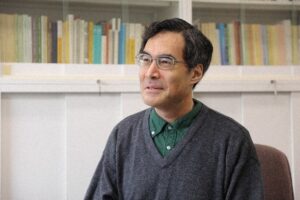
Let’s now jump forward quite a few years. We are in Princeton and the atmosphere is euphoric, as it is at the end of every semester. It’s party time, and that evening Korean professor Kim Minh-Yong was getting ready to go out. For a few days, he had not even noticed his roommate feverishly working on very advanced concepts of abstract mathematics. Ideas he was developing based on the work of the man he considered his mentor: Alexander Grothendieck. Minh-Yong said goodbye to his roommate, who obviously did not return the greeting, and left. When he got back late that night, he found Shinichi Mochizuki, his roommate, on the floor, convulsing and delirious. He was uttering incoherent phrases, talking about the ultimate essence, the deepest heart of mathematics, a shadow that had to remain veiled “for the good of us all”. With great difficulty, Minh-Yong managed to put his friend to bed and calm him down until he fell asleep. The next morning, Shinichi remembered absolutely nothing about what had happened the night before. A few years later, on 31 August 2012, Shinichi Mochizuki published four articles totalling about 500 pages on his website. These articles contained, among other things, the proof of one of the most important conjectures in Number Theory. For years, Mochizuki had worked in almost total isolation, developing a completely innovative mathematical theory that was unlike anything that had been seen before. Immediately, other mathematicians, those closest to him, since Mochizuki had not publicised his work, began to study his proof. After days and days of study, they wrote only one sentence: Impossible to understand. The following year, in December 2013, a committee of world experts met in Oxford to try to decipher Mochizuki’s work. In the meantime, the latter had become even more withdrawn and refused to give any explanation about his articles. In the early days of the committee’s work, things seemed to be starting to add up, with concepts slowly taking their rightful place, and it seemed that the Japanese mathematician’s work was beginning to make sense and be understood. Then, suddenly, everything collapsed. From a certain point onwards, no one was able to follow Mochizuki’s train of thought. The best mathematical minds on the planet were stumped. They said that the new branch of mathematics that the Japanese scholar had created to prove the difficult conjecture of Number Theory was so bizarre, abstract and ahead of its time that it seemed like a kind of mathematics coming straight from the future. The world’s greatest mathematicians were suddenly unable to speak. The heart of the proof is based on a series of relationships that form the essential basis and ultimate skeleton of that entity we commonly call Number. These relationships, again invisible at a superficial glance, transport us to an abstract world so distant and of such pure beauty “that one has the impression of being in the presence of the divine”. Mochizuki’s theory has a terrifying name: Inter-Universal Teichmüller Theory (IUT). Here too, as with Gödel, we cannot go into further detail about this highly complex theory, but what matters in Mochizuki’s proof is the procedure, and the fact that the central essence of the proof refers (as in Gödel) to the most intimate nature of Number.
Now let’s imagine ourselves in space, the ordinary space we are used to every day. In this space, which we can locally think of as mathematically flat and Euclidean without losing too much generality, the concept of “I am stationary” does not exist. Because even if we remained perfectly still, we would nonetheless be moving with respect to the time coordinate. One second at a time, towards what, in our limited linear perception, we call the future. A space of this type, flat and Euclidean, which approximates the real geometric structure of the Universe, is described by the numerical “Lambdoma”:
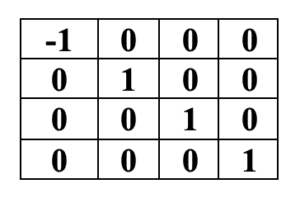
(You may have guessed that the size of the Lambdoma is 4×4 because we live in a four-dimensional manifest space). In real space, which is not approximated by Euclidean geometry, i.e. that of General Relativity, the boxes of the Lambdoma are filled with much more complex formulas. In physics, this type of Lambdoma is called the “metric” of spacetime and defines its geometry. In mathematics, the metric is a complex algebraic object called a “Metric Tensor”, but we will not deal with that here. Suffice it to say that every mathematical and physical space is geometrically described by its metric tensor, which ultimately serves to calculate the distances between two points in that space. In flat, Euclidean space, such as that described by the Lambdoma above, the distance between two points is a line segment and is calculated cartesianly using Pythagoras’ theorem.
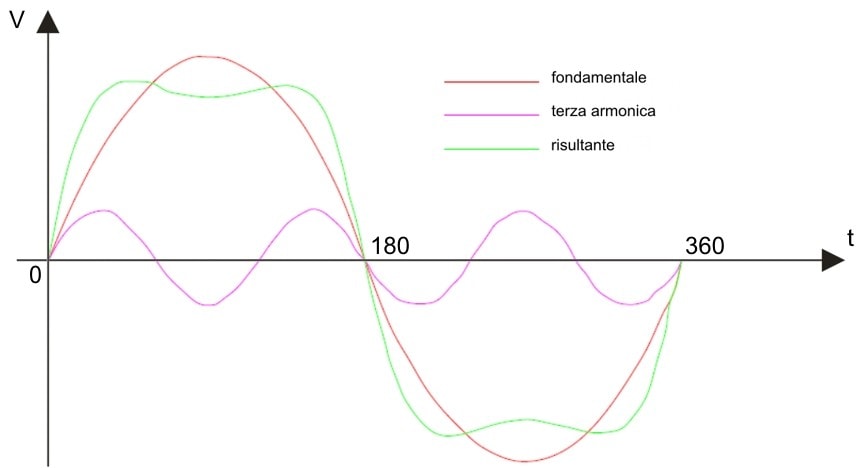
Now let’s take any mathematical function, regardless of its form and complexity, and imagine that this function, which we will generally call f, describes some entity immersed in the ordinary space we imagined earlier. Let’s now jump back three centuries. It is 1782, and French mathematician Pierre-Simone Laplace is studying how, under certain conditions, functions such as f vary in ordinary manifest space. He was particularly interested in understanding the “speed” at which f varies with respect to Cartesian coordinates. These studies of the behaviour of f led him to formulate a mathematical relationship, an equation of this type: L2f = 0. Without going into detail, the symbol L2 encompasses a series of mathematical operations that “measure” the speed at which the function f changes its mode of variation with respect to the Cartesian coordinates of space. This symbol, in honour of Laplace, is called the “Laplacian Operator” [2]. What interests us here is that, generalising and abstracting from the physical environment, all mathematical functions f that cancel out once the Laplacian operator L2 is applied to them are called “Harmonic Functions”. These functions have a repetitive pattern as the coordinates vary; in fact, Laplace’s equation L2f = 0 is also called the wave equation. It is important to clarify here that the cancellation of the Laplacian operator applied to f means that f is a solution of the operations contained in L2. One of the solutions of the expression L2f = 0 is f = sin (sine) or even f = cos (cosine). The sine and cosine functions describe a sinusoidal trend of the quantities on which they operate, as can be seen, for example, in the figure above. So, the cancellation of the Laplacian operator identifies those functions f that have a wave-like, harmonic pattern, regardless of the quantities on which f acts. There we are. We have arrived at the abstract, mathematical definition of Harmonics. Harmonics here is an idea, something that is not physically tangible, a model from which forms can manifest themselves, such as the laws of Harmonics that define sound. But to understand how this relates to the essence of Number, we need to be patient and pay a little more attention, as the level of difficulty is now increasing slightly.
When we talk about “symmetry”, most people have a general idea of what we are referring to. For example, something that is mirrored is symmetrical. True, but in mathematics, the concept of symmetry is something more extensive and abstract. To see how symmetry works in mathematics, let’s take a square table viewed from above. If we rotate it, say 45 degrees, we will certainly notice that the table is no longer in the same position as before. This is, of course, obvious. However, if we rotate the table counterclockwise (or clockwise, it doesn’t matter) by 90 degrees from its starting position, it appears to be in exactly the same position as when we started; the bottom right corner is now at the top right but the table looks exactly the same as in its initial position. How many of these rotations can we perform that leave the position of the table unchanged to the eye? Four. There are only four rotations we can perform: 90 degrees, 180 degrees, 270 degrees and 360 degrees (the 360-degree rotation of the table, as you might guess, is identical to a 0-degree rotation and is called “identity” in mathematical terms). The square table has “discrete rotational symmetry” and in maths we say that the set of symmetries of the table contains four elements: the rotations specified above. Now, if we take one of the rotations present in the set of four elements of the table and follow it with another rotation also present in this set, we will always obtain an element of the set of four symmetries of the table: for example, if I perform a 90-degree rotation and then a 180-degree rotation, I obtain the same result as if I had performed a 270-degree rotation from the outset. Another example. If I rotate the table 180 degrees and then 270 degrees, we obtain a rotation of 450 degrees, which corresponds to rotating the table 90 degrees (450 – 360). Performing one rotation after another is called “composition” of rotations in mathematics. In addition to rotating the table counterclockwise, we can decide to compose two rotations, one counterclockwise and one clockwise. For example, I can decide to rotate the table counterclockwise by 270 degrees and then clockwise by 90 degrees, resulting in a final rotation of 180 degrees. If, by combining two rotations, one counterclockwise and one clockwise, I obtain the “identity” symmetry, i.e. I return to the starting position as if I had not applied any rotation, then I define what is called “inverse” symmetry. Now let’s give an important definition: a set whose elements are symmetries and which has the three “algebraic structures” as those defined for the table, i.e. the structure of the existence of the “identity” symmetry, the structure of the “composition” of symmetries and the structure of “inverse” symmetry, is what in mathematics is called a “Group”. A Group does not necessarily have a finite number of symmetry elements. Consider, for example, the Group of rotations of a round table: in this case, any of the infinite angles between 0 and 360 degrees is an element of the set of symmetries of the round table [3]. Now that we have mastered the definition of a Group, let us consider one in which the elements of the set of symmetries are all points in a continuous space (smooth and without holes or discontinuities) with particular characteristics, that is a space where, for example, it is possible to apply the Laplacian operator L2 seen above. [4]
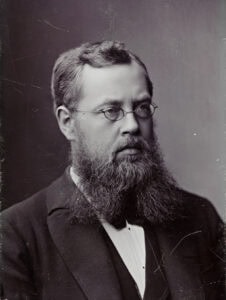
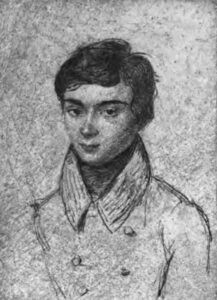
A Group that has these points as elements of the symmetry set is called a Lie Group, named after the Norwegian mathematician Sophus Lie, who introduced it around 1870. In addition to the Lie Group, we are also interested in another group: the Galois Group, named after the French mathematician Évariste Galois, who was the first to study symmetries in the field of numbers. Let’s arrive at the definition of the Galois Group step by step. Let’s take the set of Natural numbers, namely the numbers we use every day to count. As we know from primary school, we can perform the four operations on this set: Addition, Subtraction, Multiplication and Division. The set of Natural Numbers is “closed” with respect to only two of these operations: Addition and Multiplication. In fact, adding two or more Natural numbers always gives us a Natural number, just as multiplying two or more Natural numbers always gives us a Natural number. What happens now if we subtract a greater Natural number from a smaller one? We leave the set of Natural numbers because we obtain a negative number, which is not a Natural number. By adding negative numbers as an “extension” to the set of Natural numbers, we obtain the set of Integers [5]. When we add an extension (such as negative numbers) to a numerical set (such as Natural numbers), we obtain what is called a “Number Field”. Now, a Galois Group is a Group whose elements of the set of symmetries are formed by the elements that represent the extension that forms a Number Field. For this article, Lie Groups and Galois Groups are of interest to us because they are studied by a branch of mathematics called Representation Theory, which studies particular algebraic structures, precisely such as Groups. In particular, Representation Theory studies how Groups in general (and Lie and Galois Groups in particular) can be “represented” by linear transformations (i.e. a transformation that takes one object and transforms it into another object, keeping the internal algebraic structure intact) on vector spaces. [6]
Representations allow us to construct abstract objects that help us study how a Group (or, more abstractly, an Algebra) acts on and transforms a vector space. Here, we must not overlook a profound change in perspective. While Groups represent “static” mathematical entities, with their elements and algebraic relations of identity, composition and inverse symmetry, Representations focus on dynamic aspects of transformation, just as the Laplacian operator did, which “represented” a motion of variation of a function with respect to its Cartesian “extension” and served to define a Harmonic Function. For geometric transformations of vector fields, the Representation Theory uses the Lie Group of symmetries on the vector space through which Harmonic Functions are also characterised, while for numerical transformations on numerical fields, the Representation Theory uses the Galois Group acting on the Numberl Field under consideration. Now, without going into too much detail, from the study of Lie Group Representations and the study of Galois Group Representations emerge some essential common entities called Automorphic Forms. These abstract entities incorporate some of the essential ideas underlying both Algebraic Geometry (a branch of mathematics that also defines harmonic functions) and Number Theory.
These abstract entities are made up of pure relations. What matters here is not the type of object to which they apply, but the relationships that are woven between these objects. It doesn’t matter whether we are talking about Space, with its metric Lambdoma, Number or Harmonics, each of these fields of application has a common Automorphic Representation residing at a higher level of abstraction from which specific manifestations descend. Such abstract entities are constructed and described in Mochizuki’s Inter-Universal Teichmüller theory mentioned at the beginning and have a name, they are called Frobenioids. To this day, the IUT is still being studied by the world’s greatest mathematical minds, some things have been understood, others remain a mystery. Will it come to light what Mochizuki meant when he said that some things should remain veiled for the good of us all? The fact is that even today, more so than then, Shinichi Mochizuki refuses to make any comment on this work that drove him almost to madness. Even his articles have been removed from his personal website with Mochizuki banning publication in the original and in any other form [7]. Fortunately, the originals still exist in academies and are still the subject of deep study and frontier research by the mathematical community. Another branch of mathematics, Categorical Logic, would show that these Automorphic Representations can also be applied to Gödel’s demonstration of syntactic incompleteness, which would help the work of abstraction on the dichotomy between semantics and syntax, Truth and Proof, already formalised by Gödel in his 1930 work, thus unifying algebraic Geometry, Number Theory and Mathematical Logic under a common theory.
It’s easy to guess that what is taught in schools has nothing to do with real mathematics, the one to which scholars devote their lives in study and research. It is as if in art schools, they only called Art the technique of painting a wall, without mentioning Leonardo or Michelangelo and other great artists who gave dignity to their discipline. So it is with mathematics. Numbers are not just quantitative tools for counting as we are taught in school. On this false notion, many, believing that mathematics is all there (in its didactic sterility), and without taking the trouble to go further, in their narrowness criticise the academies without knowing the enormous amount of study and research work that modern mathematics requires. In relation to the esoteric studies on Harmonics, what is presented here approaches it from a different sapiential perspective, the state of the art of modern scientific-mathematical research that, with different tools and different times, will come to say the same things that the ancients already knew. Mathematical abstraction takes us into worlds of such essential beauty that it is like having escaped Plato’s cave and come face to face with pure Truth. The meaning of mathematics is the same as that of art: the creation of intrinsic beauty. It is beauty, not utility, that is the true justification for mathematics. The forms created by the mathematician, like those created by the painter or the poet, must express beauty. We therefore do not need to create new arithmetics or geometries with bombastic names or odd theories about numbers. Everything we need is already here. And many other things await us, still veiled. A whole sea to navigate and discover.
A great adventure.
_______________________________________________________________________
[1] To be clear about the terms (that must necessarily be precise in this discipline), here, and in articles of this kind, “science” is only understood in the way the dictionary defines it: “Science is the set of disciplines based essentially on observation, experience, calculation, or which have nature and living beings as their object, and which make use of formalised languages”.
[2] Here is the link for further information about this operator: https://en.wikipedia.org/wiki/Laplace_operator
[3] In fact, this group is called the Circumference Group.
[4] It is by no means a given that all spaces have this characteristic. Technically, space must be continuous and infinitely differentiable at every point. A space of this type is called a Differential Manifold. For example, a straight line with discontinuities or cusp points (a cusp is a point where a curve changes direction abruptly, such as the sharp peak of a mountain compared to the gentle roundness of a hill) is not differentiable at the discontinuities and cusps and is therefore not a Differential Manifold.
[5] The same thing happens with division, resulting in an extension of the Natural numbers that we call Rational Numbers.
[6] Let us recall here the difference between scalar space and vector space. A scalar space is, for example, that of temperatures: each point in space is associated with a number representing a temperature. A vector space, for example, is that of winds: each point in space is associated with a number representing the intensity of the wind and also with a direction.
[7] However, the four articles of the IUT in the revised 2020 version can be found on this website: https://www.kurims.kyoto-u.ac.jp/~motizuki/papers-english.html