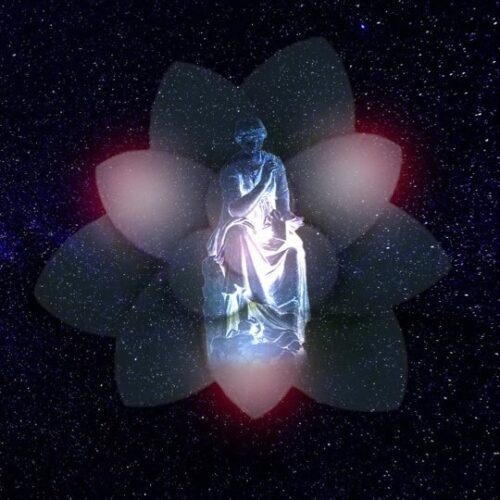
The Orphic hymns refer to Mnemosyne, the Mother of the Muses, as “… the wife of Zeus, the sovereign who gave birth to the sacred, holy Muses with their melodious voices … and who awakens in the initiates the memory of the sacred celebration…”. (1)
Mnemosyne is thus the ancestral memory of that which has not yet come to pass in the formal world and, as such, is ready to be moulded into dance by the powerful, creative song of her daughters, the Muses.
This archetypal Muse, who reminds us of the unfathomable depth of the Substance ready to be fertilised by the touch of the Fire of Life, comes before creation, before any manifest being, for it was She who initiated the creative process and thus belongs to two worlds: the uncreated and the created, the invisible and the visible, the Unknown and the known.
Mnemosyne bridges the gap between Mythos—the Word/Sound that precedes all manifestation, even the gods themselves—and Logos, the Word/Song that gives form to creation, endowing it with value and beauty; a transition which, in turn, the inspired human being can use to recognise and recreate the Unknown in ever-new ways. The Mother of the Muses thus stands at the beginning of every possible revelation, where memory is not yet filled with recollections, but, virgin and immaculate, waits for the multiplicity of the manifest to unfold upon the spiral of becoming that appears to us humans in the form of shapes, distance and time.
The Muse, on the other hand, is intimate with the One from whom all things spring, and, as Niccolò Cusano, the theologian, philosopher, mathematician and astronomer of the XV century, reminds us, “In eternity … every succession coincides in the instantaneous being of eternity. Nothing is therefore past or future, where the future and the past coincide with the present.” (2)
Within the realm of this eternity, where the future has already come to pass because it coincides with what has already been and can be remembered, Mnemosyne weaves the veil of existence and calls us back to the Unity of the Whole that contains everything.
The Teaching, too, urges us to explore the Unknown, stating “Direct the spirit into the unknown! Such striving will bring about new ways of thinking.” (3); and it is with hearts brimming with ardent courage that we lift our eyes to the Heavens to contemplate and reflect upon the signs traced by the celestial entities.
The eye which today, according to the heliocentric perspective, sees the asteroid Mnemosyne hugging the Earth in a maternal embrace within the substantial waters of Capricorn, can penetrate the depths of the Heart which, beyond the confines of the concrete intellect, brings back into the bosom of consciousness that which the mind does not comprehend but which the spirit has always known.
The Unknown cannot be known, but only re-called, that is, brought back to the heart, as Plato teaches (4), according to whom our immortal soul, which before incarnating has already contemplated the perfect Ideas in the Hyperuranion, through a process of reminiscence induced by sensory experience, has the capacity to bring to the surface of consciousness that which is apparently unknown to it.
Reminiscence thus takes the form of the reawakening of the soul’s memory through sudden and dazzling, albeit discontinuous, flashes; it is the reviving of a knowledge already deeply present within our soul, which, in Plato, takes the form of a transition from concrete, intellectual knowledge to direct knowledge—an intuitive knowledge that, step by step, ensures the unveiling of the One/Good.
“The vision of the One – Plotinus reminds us – is beyond knowledge: knowledge of Him is attained neither through science nor through thought, but through a presence that is worth more than science. (…) He is present, but He is present only to those who can receive Him and who have prepared themselves to harmonise with and come into contact with Him by virtue of an affinity and a power inherent in Him, consubstantial with that which derives from Him.” (5)
The transition from intellectual knowledge to direct knowledge—necessary for recalling the Unknown—is today also aided by the asteroid-Muse Melpomene, also present in Capricorn, which, in conjunction with Earth and Mnemosyne, teaches the tenacity and perseverance required to attain that which is not yet known but is recognised deep within the consciousness as True, Beautiful and Good.
Melpomene preserves the integrity and virtues of humankind, its connection with the cosmos, and does so by showing that there is no divide between the invisible and the visible, between the real and the apparent, between the Unknown and the known, for both are necessary to build the path of Life.
This eternal quest for that which we do not know, yet know to exist, also carries within it the clamour of the inner battle that transfigures our vehicles, leads from intellect to intuition, and throws open the gates of the finite, beyond which dwells the ineffable that the heart calls the Infinite.
And it is Niccolò Cusano once again who attests to this leap into the abyss of what is not known, which ultimately reveals the Unknown (Cusano’s ‘God’) in ways incomprehensible to the mind: “Lord God … I cannot give you a name, for I do not know what you are. If someone were to tell me that you are called by this or that name, I already know, from the very fact that they name you, that this is not your name. (…) And if someone were to conceive of a certain way of thinking of you, I know that that concept is not yours. (…) And if someone were to devise some likeness in order to conceive of you in this way, I know equally well that that is not a likeness suited to you. And if someone were to set about describing the understanding he has of you, wishing thus to offer a way of understanding you, he is still very far from you.” (6)
The same author offers us the means by which to access the Unknown, a means free from elaborate mental sophistry yet capable of grasping the Absolute—which fills the heart of every living being—in a direct and indisputable manner: “It is necessary that whoever approaches you should rise above every limit and end, and above every finite thing. (…) You cannot therefore be approached, O God, who are infinity, except by one whose intellect is in ignorance, that is, by one who knows that he does not know you. But how can the intellect know you, if you are infinity? The intellect knows that it does not know you and cannot contain you, because you are infinity. To comprehend infinity is to grasp the incomprehensible. The intellect knows that it does not know you, because it knows that you cannot be known unless the unknowable is known, unless the invisible is seen, unless the inaccessible is reached.” (7)
Here, then, is the door that leads to the Unknown, that door the keys to which, as the Teaching attests, are “To see with the eyes of the heart; to hear the roar of the world with the ears of the heart; to peer into the future with the understanding of the heart; to remember past accumulations through the heart—that is how the aspirant must boldly advance on the path of ascent.” (8)
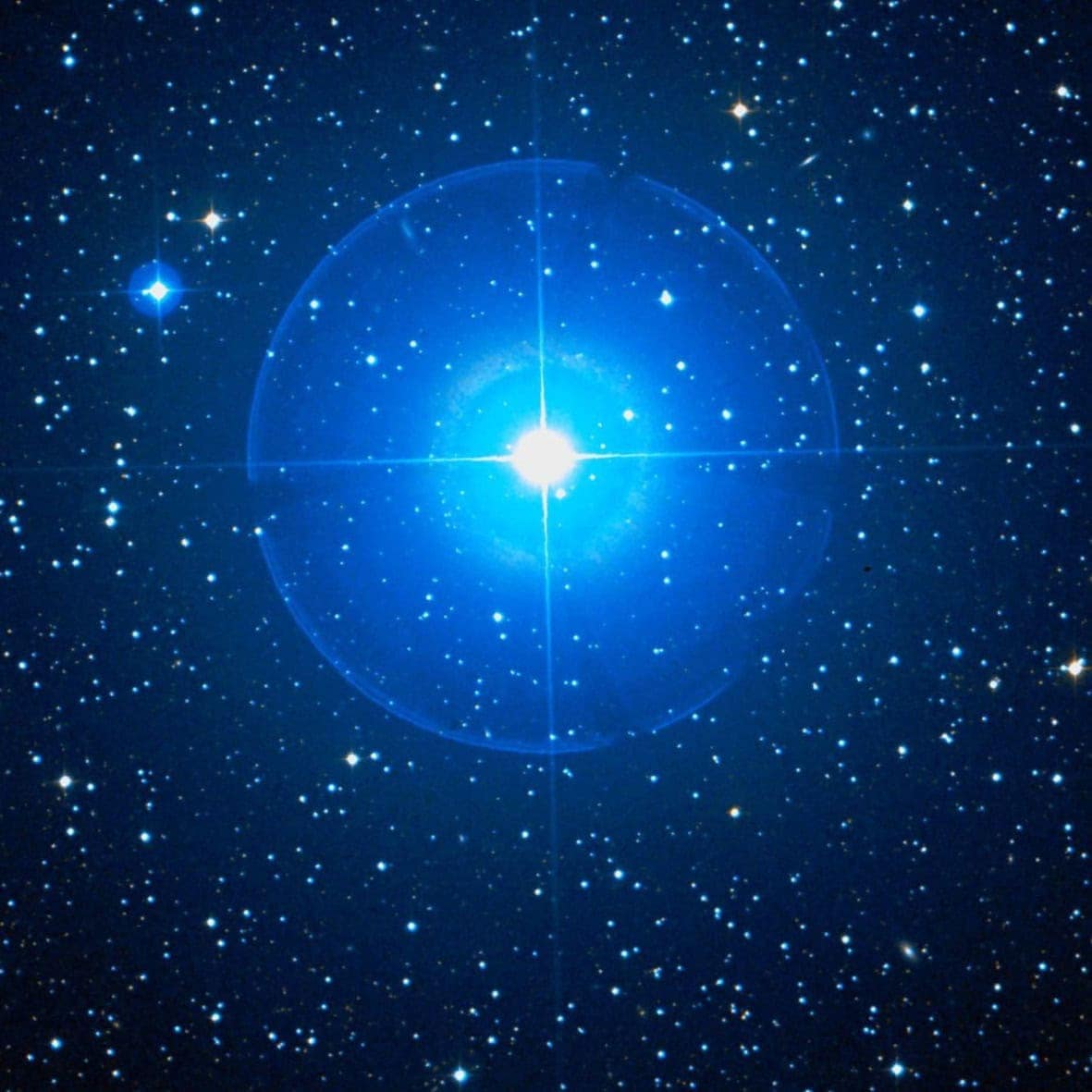
And in the heavens, on the path of ascent, another one also appears: the Way of the Heart, which leads to the Heart of Hearts, the luminous and magnetic star Sirius, now in conjunction with the Sun—the burning Heart of the Solar System—against the background of the constellation of the Twins and the Sign of Cancer.
Earth and Sun are thus illuminated by the power of the images of the Mother of the World, eternal symbols that enlighten minds and enable Humanity to generate Beauty and Harmony in turn: Mnemosyne, the sacred archetypal matrix, and Sirius, the cosmic source of Buddhi-Manas, cosmic Love, the principle found at the heart of every atom.
Along the Capricorn–Cancer axis, therefore, burns a sacred vital impulse towards the supernal Light and spiritual Love.
A Love that pulsates ceaselessly even in the waters of Gemini (the primary source of the 2nd Ray of Love and Wisdom) and which today sees Uranus, Lord of Order and Rhythm, conjunct with the asteroid-Muse Urania, She who sings the Wisdom of Heaven and through whom, keeping one’s gaze fixed on the eternal celestial Model, one returns to the One and from this penetrates into the Infinite, the two inscrutable names of the Unknown.
For thousands of years, humankind has left behind evidence of its ceaseless – and often dramatic – quest for the unknowable, as the Vedas so eloquently tell us in this sutra “I ask, like a madman who knows not his own spirit: where are the hidden traces left by the gods?” (9)
The traces of the divine lie within our hearts, well hidden in the depths of our consciousness, safely protected from the assaults of the shadow, and patiently awaiting the moment when the supernal Light reaches them, illuminates them, and enables the heart to remember the splendour of the Spirit and how to set out on the path of return.
““The eyes and ears can be deceived,
but nothing can delude the heart.”
(Agni Yoga § 520)
1. Orphic Hymns, 76, 77
2. Niccolò Cusano, The vision of God
3. Agni Yoga Series, Agni Yoga § 294
4. Plato’s theory of ‘reminiscence’ is set out most prominently in the dialogue Meno, in which Socrates questions an illiterate slave, guiding him – through the art of maieutics, the Socratic counterpart to reminiscence – towards the solution to the problem. In this way, Plato seeks to demonstrate that knowledge is innate and merely needed to be ‘remembered’. Thus we read in the Meno: “How will you look for it, Socrates, when you do not know at all what it is? How will you aim to search for something you do not know at all? If you should meet with it, how will you know that this is the thing that you did not know? SOCR.: I know what you want to say, Meno. Do you realize what a debater’s argument you are bringing up, that a man cannot search either for what he knows or for what he does not know? He cannot search for what he knows—since he knows it, there is no need to search—nor for what he does not know, for he does not know what to look for.” [Meno, 80d-e] “As the soul is immortal, has been born often, and has seen all things here and in the underworld, there is nothing which it has not learned; so it is in no way surprising that it can recollect the things it knew before, both about virtue and other things. As the whole of nature is akin, and the soul has learned everything, nothing prevents a man, after recalling one thing only—a process men call learning—discovering everything else for himself, if he is brave and does not tire of the search, for searching and learning are, as a whole, recollection.” [Ibid., 81c-e]
5. Plotinus, Enneads, VI, 9,4
6. Niccolò Cusano, op. cit.
7. Ibid.
8. Agni Yoga Series, Heart § 1
9- RigVeda I, 164, 5b